
5 Mistakes When Installing Office Air Conditioners That Double Your Electricity Bill
In the summer, electricity bills are always one of the operational expenses that give many businesses a headache. Not a few offices record electricity bills increasing by 30-70%, or even doubling compared to normal months, even though the usage time does not change significantly.
Many people think the cause stems from the continuous use of air conditioning. However, in reality, mistakes when installing air conditioners are the silent factors causing the system to operate inefficiently, consume a lot of electricity, and quickly degrade.
Properly installing office air conditioners not only helps maintain a stable temperature and create a comfortable working environment but also contributes to office electricity savings, extending equipment lifespan and significantly reducing long-term maintenance costs.
Below are 5 common mistakes that many businesses are facing.
Mistake 1: Choosing the wrong capacity when installing office air conditioners
Causes
Many businesses choose air conditioner capacity based solely on room area while ignoring important factors such as:

- Number of working employees
- Number of computers and electrical equipment
- Sun exposure direction of the office
- Ceiling height and insulation level
For example, an 80m² office with 20 employees will have a much larger heat load than a meeting room of the same area but with fewer occupants.
Consequences
When the capacity is too small, the compressor must operate continuously at high load to try to reach the set temperature.
This leads to:
- Sharply increased power consumption
- The machine runs continuously but is still not cold enough
- Machine lifespan decreases rapidly
- Higher incurred repair and maintenance costs
Conversely, if the capacity chosen is too large, the machine will continuously cycle on/off in a short time, causing a waste of electricity and reducing dehumidification efficiency.
Solutions
To make office air conditioners operate efficiently, it is necessary to:
- Survey the actual heat load before designing.
- Calculate capacity based on area, number of people, and electrical equipment.
- Buffer a reasonable spare capacity for future expansion capability.
- Select VRV/VRF or Multi systems for offices with many different operating areas.
Mistake 2: Unreasonable installation positions for outdoor and indoor units
Causes
Not a few construction projects prioritize convenient locations for installation while ignoring factors that affect heat exchange efficiency.
Common errors include:
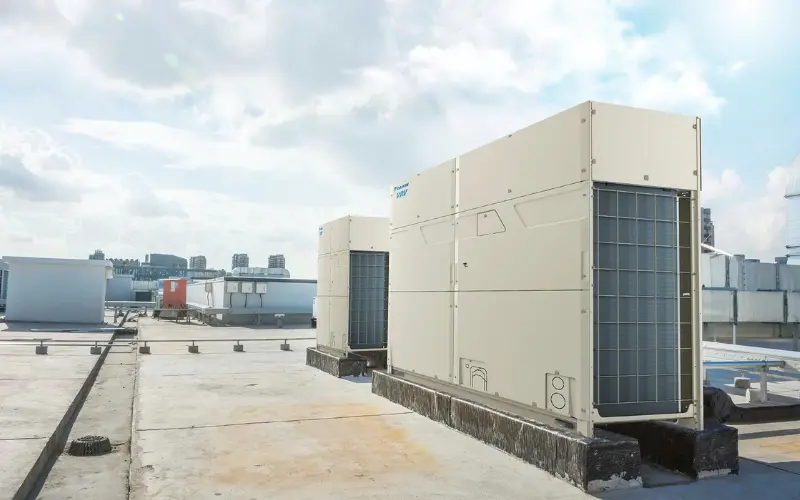
- Outdoor unit placed on a corrugated iron roof, absorbing direct heat.
- Outdoor unit is covered, lacking ventilation space.
- Indoor unit blows directly onto glass walls that receive a lot of sunlight.
- Airflow is blocked by pillars, cabinets, or blind corners.
Consequences
When the outdoor unit works in an environment where the temperature is too high, the condensation pressure increases, causing the compressor to consume more electricity.
Meanwhile, a poorly positioned indoor unit will cause uneven distribution of cold air. Some areas will be too cold, while other locations remain hot, forcing users to continue lowering the set temperature.
This is the reason why electricity bills increase significantly even though the set temperature is always kept at a low level.
Solutions
To install office air conditioners efficiently, you should:
- Arrange the outdoor unit in a well-ventilated place, avoiding direct sunlight.
- Ensure ventilation clearance distances according to the manufacturer’s recommendations.
- Design the indoor unit’s airflow direction to cover the entire workspace.
- Restrict installation opposite glass walls or doors that open frequently.
Mistake 3: Failing to consider the office’s insulation factors
Causes
An office that uses a lot of glass or has doors that open frequently will continuously receive heat from the outside.
Common issues include:
- Glass walls without heat insulation film applied.
- Curtains are not capable enough against the sun.
- Doors opening and closing continuously.
- Door gaps causing cold air leakage.
Consequences
Even when using a modern air conditioning system, the continuous penetration of heat will cause the machine to operate with almost no rest.
This leads to:
- High power consumption.
- Reduced cooling capacity.
- The space always feels hot despite the machine still operating.
- Rapid equipment wear and tear due to continuous operation.
Solutions
To save office electricity, businesses should:
- Apply heat insulation film to the entire glass system.
- Use high-quality sunshade curtains.
- Check and seal door gaps.
- Design anterooms or automatic doors for high-traffic areas.
Improving insulation can help significantly reduce the cooling load and save millions of VND in electricity bills every month.
Mistake 4: Running copper piping too long or technically incorrectly
Causes
During the construction process, many contractors run convoluted copper piping for convenience or use substandard materials.
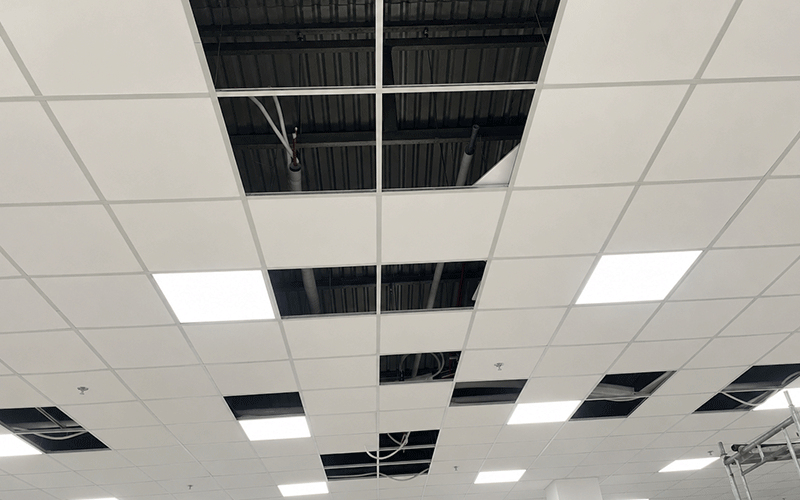
Common errors include:
- Pipe length exceeds recommendations.
- Bending too many times.
- Incomplete thermal insulation.
- Connections fail to ensure technical standards, causing refrigerant leakage.
Consequences
Long piping increases pressure drop and reduces heat exchange efficiency.
If a refrigerant gas leak occurs, the system will:
- Cool slowly.
- The compressor operates longer.
- Higher power consumption.
- Easily generate faults and damage.
Many businesses only discover the problem when electricity bills increase unusually or the air conditioner is no longer cold enough.
Solutions
To avoid mistakes when installing air conditioners, it is necessary to:
- Design the shortest and most optimal pipe run.
- Use copper pipes that meet the correct standards for thickness and diameter.
- Insulate the entire system completely.
- Test for tightness and vacuum correctly according to the procedure before charging gas.
A standard piping system will help the air conditioner operate stably for many years without causing refrigerant depletion.
Mistake 5: Neglecting the ventilation system
Causes
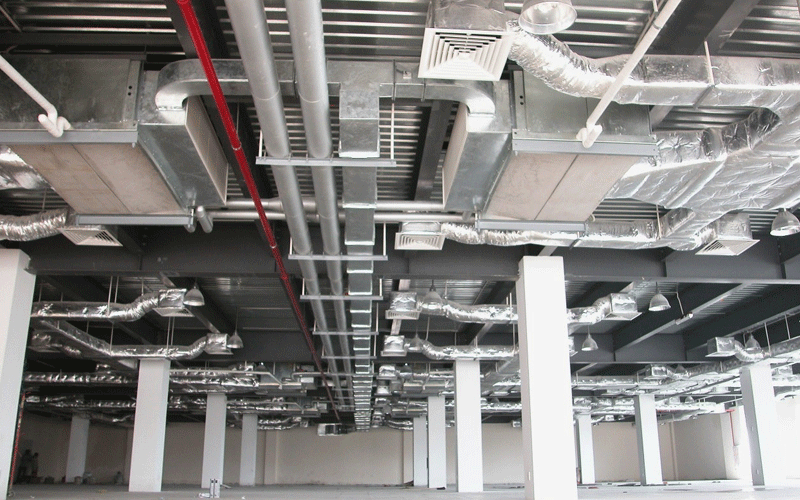
Many offices only focus on investing in the air conditioning system without designing a fresh air supply and exhaust air extraction system.
A closed space with many people and electrical equipment will accumulate:
- Heat load
- CO₂
- Unpleasant odors
- Excess humidity
Consequences
The air in the room becomes increasingly hot and deficient in oxygen, forcing the air conditioner to work continuously to compensate for the accumulated heat load.
In addition to consuming electricity, the working environment becomes stuffy, affecting the health and productivity of employees.
This is a common error in renovated or expanded offices that do not upgrade the ventilation system.
Solutions
To optimize the efficiency of office air conditioners, you should:
- Design a standard fresh air system.
- Arrange exhaust fans suitable for the area.
- Integrate a heat recovery system if the office is large-scale.
- Clean and maintain the ventilation system periodically.
The combination of air conditioning and ventilation will help maintain good air quality, reduce the load on the air conditioner, and enhance the efficiency of office electricity savings.
Conclusion
An efficiently operating air conditioning system depends not only on the brand or technology but also lies in the initial design and construction phases. Just a few mistakes when installing air conditioners, such as choosing the wrong capacity, arranging unreasonable outdoor units, lacking insulation, running pipes technically incorrectly, or neglecting ventilation, can also cause electricity costs to increase significantly.
Therefore, before installing office air conditioners, businesses should choose a reputable unit with experience in surveying, calculating cooling loads, and executing construction according to proper technical standards. This is an investment that helps reduce operational costs, extend equipment lifespan, and bring stable long-term usage efficiency for many years, instead of having to pay ever-increasing daily electricity bills over time.
Dong Sapa – Professional M&E contractor, with over 23 years of experience, we specialize in providing optimal air conditioning and ventilation design and construction solutions, helping to enhance cooling efficiency, save office electricity, and ensure stable, durable system operation in the long run.
Other news