

Villa Air-Conditioning: Which System Is Best for Your Villa?
A villa requires more than adequate cooling capacity. Large floor areas, multiple stories, high ceilings, extensive glazing, and demanding interior design requirements mean the air-conditioning system should be planned as an integral part of the building’s architecture and overall MEP design.
A well-designed villa air-conditioning system should provide effective cooling, quiet operation, energy efficiency, independent room control, and minimal visual impact. Modern villa projects are also placing greater emphasis on fresh-air ventilation, air filtration, and Smart Home integration. So which solution is the better fit: VRV/VRF, multi-split, or ceiling-concealed ducted air conditioning?
1. Why villa air-conditioning requires a different approach
1.1. Large spaces and complex cooling loads
Unlike a typical apartment or townhouse, a villa usually includes spaces with very different usage patterns, such as a large living room, bedrooms, a family room, a home office, a dining room, and a kitchen, …
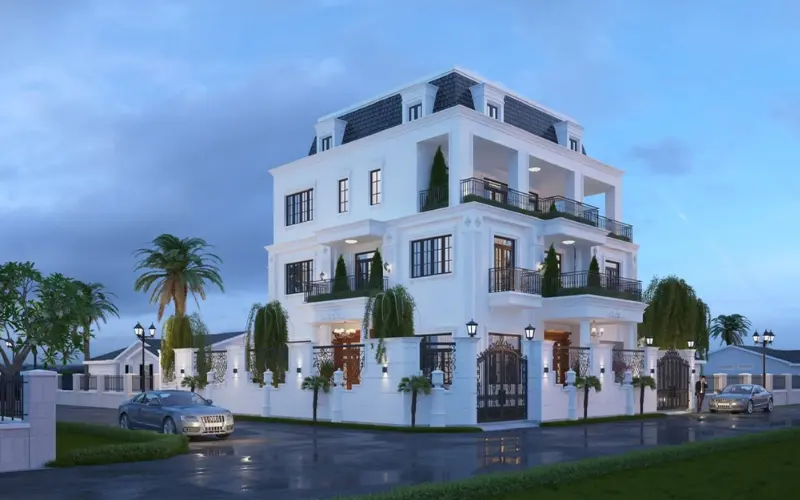
Cooling loads also vary depending on sun exposure, glazed area, ceiling height, occupancy, heat-generating equipment, and hours of use. For this reason, a villa air-conditioning system should not be sized simply by applying a fixed BTU-per-square-meter value across the entire building.
A professional HVAC design should calculate the cooling load for each zone before equipment capacity and system configuration are selected.
1.2. Aesthetics and comfort are equally important
For villas, the HVAC system also needs to integrate seamlessly with the architecture. Homeowners generally do not want rows of outdoor units cluttering balconies or building facades, while indoor units and air diffusers should be carefully coordinated with ceilings, walls, and interior finishes.
A premium villa air-conditioning system should also provide low noise levels, comfortable airflow, and independent temperature control for each room.
2. Three popular air-conditioning solutions for villas
2.1. VRV/VRF central systems – a strong option for upscale villas
A VRV/VRF system uses a single outdoor unit or a combination of outdoor units connected to multiple indoor units, with refrigerant flow adjusted according to the cooling demand of each operating zone.
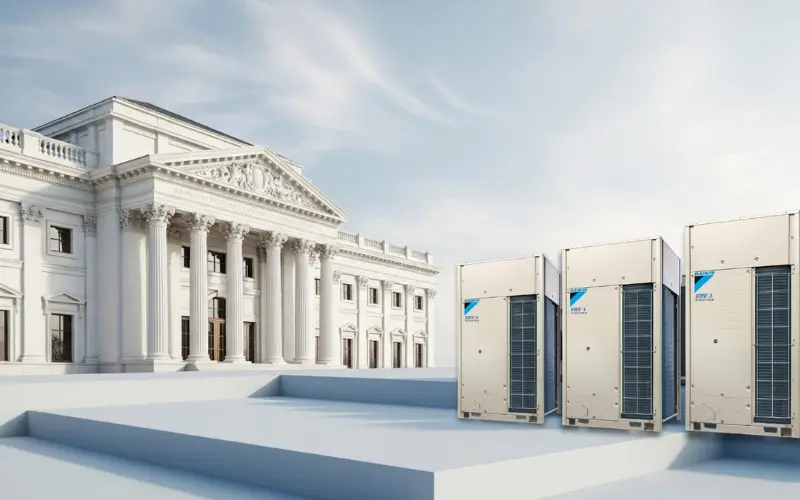
A single system can support different indoor unit types, including cassette, wall-mounted, and ceiling-concealed ducted units. This flexibility makes VRV/VRF particularly well suited to larger villas with multiple rooms.
Advantages:
- Significantly reduces the number of outdoor units compared with multiple standalone split systems.
- Allows independent temperature control by room or zone.
- Inverter technology adjusts system capacity to match actual cooling demand.
- Flexible refrigerant piping layouts accommodate multi-story buildings.
- Ceiling-concealed indoor units can be used to preserve interior aesthetics.
- Depending on the system, integration with centralized controls, a Building Management System (BMS), or Smart Home platforms may be available.
Limitations:
The initial investment for a VRV/VRF system is relatively high. Refrigerant piping, condensate drainage, electrical power supply, equipment locations, and maintenance access all need to be carefully planned from the outset.
System performance therefore depends not only on equipment quality, but also on the contractor’s HVAC design and installation capabilities.
>>> READ MORE: 7 VRV System Advantages Property Owners Should Know
2.2. Multi-split systems – a practical option for mid-size villas
A multi-split system connects multiple indoor units to a single outdoor unit. It is worth considering when reducing the number of outdoor units is a priority but the project does not require the capacity or scale of a full VRV/VRF system.
For villas, a multi-split system requires less outdoor-unit space, generally has a lower initial investment, and can support different indoor unit types depending on the product line.
This option is generally better suited to small to mid-size villas with a moderate number of rooms.
However, the number of connectable indoor units, total connected capacity, piping length, and system expandability vary by model. Technical specifications should therefore be reviewed carefully before the final configuration is selected.
2.3. Ceiling-concealed ducted units – aesthetics and design flexibility
With a ceiling-concealed ducted unit, the indoor unit is installed above the ceiling and remains out of sight. Occupants primarily see the supply and return air diffusers, which can be coordinated with the interior design.
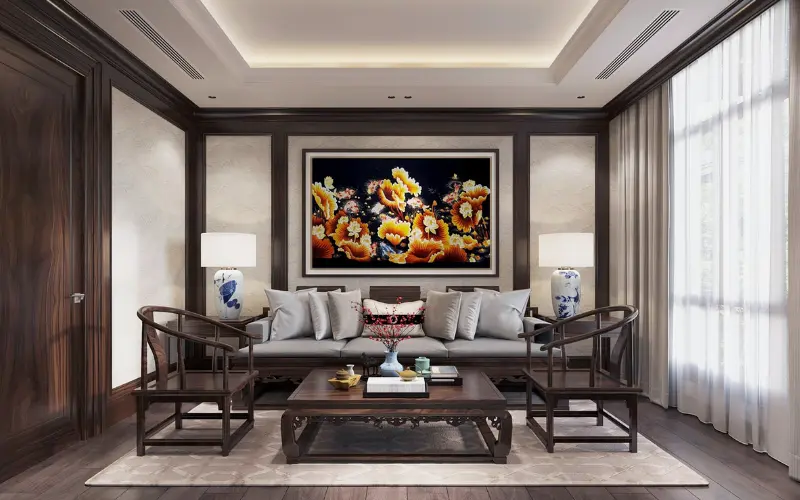
This configuration is particularly well suited to living rooms, dining rooms, master bedrooms, and other spaces with demanding aesthetic requirements.
Key advantages:
- The indoor unit is concealed above the ceiling.
- Air diffusers can be selected and positioned to complement the interior design.
- Properly designed ductwork and diffusers provide flexible airflow distribution.
- The concealed installation helps create a clean, refined interior.
Adequate ceiling void space is required, while ductwork, return air, condensate drainage, and maintenance access must be properly designed.
More importantly, a ceiling-concealed ducted unit is an indoor unit configuration rather than an alternative system technology to VRV/VRF. It can be integrated into either a VRV/VRF or compatible multi-split system. This is also a popular villa air-conditioning configuration for upscale projects where architectural aesthetics are a priority.
3. Quick comparison: VRV/VRF, multi-split, or ducted units for villas?
|
Criteria |
VRV/VRF |
Multi-split |
Ceiling-concealed ducted |
|
Suitable Scale |
Mid to large |
Small to mid |
Depends on connected system |
|
Aesthetics |
Very high |
High |
Very high |
|
Zone contro |
Good |
Good |
Depends on system |
|
Expandability |
High |
Moderate |
Depends on system |
|
Initial investment |
High |
Moderate |
Moderate to high |
|
Upscale villas |
Highly suitable |
Suitable |
Highly suitable |
For large villas with multiple rooms and demanding requirements for both independent control and aesthetics, a VRV/VRF system combined with ceiling-concealed ducted indoor units is often a strong option.
However, no single villa air-conditioning configuration is suitable for every project. The final selection should be based on cooling loads, architectural requirements, usage patterns, and budget.
4. Modern villa air-conditioning trends: more than just cooling
4.1. Smart home and IoT integration
In modern villas, HVAC is increasingly becoming part of the Smart Home ecosystem.

Depending on the selected system and equipment, villa air conditioning can be integrated with centralized controls or Smart Home platforms, enabling room-by-room temperature control, smartphone access, operating schedules, and customized operating scenarios.
For example, the system can be configured to reduce output in unoccupied rooms or operate automatically according to the household’s schedule. This provides a more convenient user experience beyond basic on/off and temperature control.
4.2. Growing demand for indoor air quality and fresh-air ventilation
A common misconception is that air conditioning alone fully addresses indoor air quality.
In practice, air-conditioning systems primarily manage temperature and humidity according to their design. A tightly enclosed, heavily glazed villa operating air conditioning for extended periods still requires appropriate fresh-air supply and exhaust ventilation.
Modern villa HVAC solutions can therefore be coordinated with ventilation systems, air filtration equipment, or suitable ERV/HRV solutions to introduce treated outdoor air while limiting energy losses..
Technologies such as HEPA filtration, Nanoe-X, and plasma air purification may also be considered, but specific features vary by manufacturer and model and should not be assumed to be standard across all equipment.
4.3. Concealing HVAC equipment to preserve architectural aesthetics
Current villa air-conditioning design trends favor discreet installations that keep indoor units and piping out of sight, helping preserve a clean and refined interior.
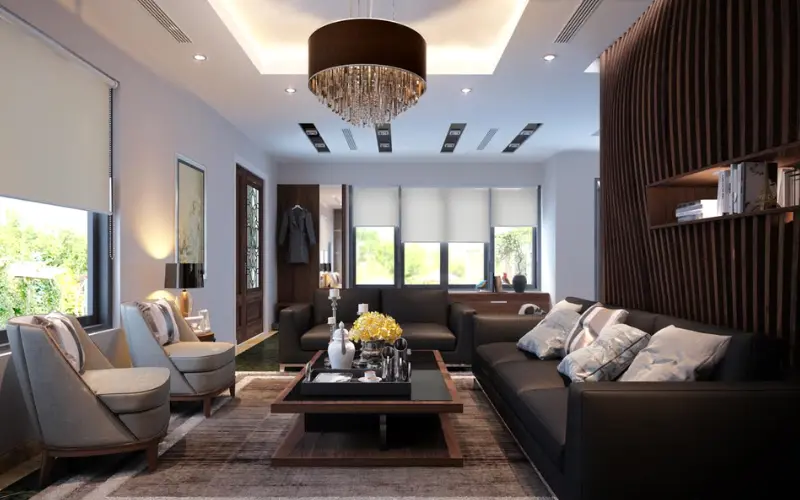
Indoor units concealed above the ceiling, linear slot diffusers, and air outlets coordinated with the interior design allow the HVAC system to blend into the architecture. Outdoor-unit locations should also be planned early to provide adequate ventilation and service clearance without compromising the building facade.
Achieving this requires early coordination between HVAC, architectural, interior, electrical, and other MEP disciplines before ceiling installation, rather than determining equipment locations after the interior has already been completed.
5. Five criteria for choosing the right villa air-conditioning system
5.1. Floor area and actual cooling load
System capacity should not be selected based on floor area alone. Sun exposure, glazed area, ceiling height, occupancy, and internal heat sources can all significantly affect the actual cooling load.
5.2. Architecture and interior design
The design should confirm whether sufficient ceiling void is available for indoor units and ductwork, where air diffusers should be located, and whether technical areas can properly accommodate outdoor units.
5.3. Room usage patterns
Living rooms, bedrooms, home offices, and family rooms have different usage patterns. A villa air-conditioning system should provide appropriate zoning and control to avoid unnecessary operation in unoccupied areas.
5.4. Initial investment and operating costs
Equipment price should not be the only consideration. An HVAC solution should be evaluated based on total cost, including equipment, materials, installation, energy consumption, maintenance, and long-term operating requirements
5.5. Homeowner comfort requirements
Noise levels, fresh-air supply, air filtration, Smart Home integration, diffuser design, and remote-control requirements should all be defined early in the design of a villa air-conditioning solution.
6. Which air-conditioning brand is suitable for a villa?
The market offers several HVAC brands suitable for villas and upscale residential projects.
- Daikin offers a broad VRV product range used across residential and commercial applications.
- Mitsubishi Electric and Mitsubishi Heavy offer multi-split and VRF product lines with configurations suited to projects that prioritize performance and operating reliability.
- Panasonic offers a broad equipment portfolio, with selected product lines incorporating technologies that support indoor air quality.
- Toshiba also provides VRF and commercial air-conditioning solutions for a range of project configurations.
Rather than asking which premium villa air conditioner is the “best,” a more useful question is which brand and model best match the project’s cooling load, architecture, budget, control requirements, and maintenance conditions.
7. Dong SaPa – villa HVAC design and installation
As an experienced HVAC contractor, Dong SaPa provides consulting, design, and installation services for air-conditioning and ventilation systems across a wide range of projects.

For villa HVAC projects, system planning should not begin with an equipment quotation alone. The contractor should first conduct a site survey and coordinate the architectural layout, cooling loads, indoor and outdoor unit locations, refrigerant piping, condensate drainage, ductwork and diffusers, fresh-air ventilation, and Smart Home integration as part of an overall system design.
For new villas or projects still in the interior fit-out stage, early HVAC design makes it easier to optimize technical space, preserve architectural aesthetics, and minimize costly modifications later in the project.
A successful villa air-conditioning solution is therefore not simply about selecting high-quality equipment. It is about designing an HVAC system that fits the building’s actual requirements.
8. Conclusion – Which villa air-conditioning solution should you choose??
For small to mid-size villas with fewer rooms, a multi-split system is worth considering. For larger, multi-story villas requiring flexible zone control, VRV/VRF offers significant advantages. Where architectural aesthetics are a priority, ceiling-concealed ducted indoor units can be incorporated into a compatible system configuration.
More importantly, modern villa air conditioning should be approached as an integrated system that brings together cooling, fresh-air ventilation, air filtration, smart controls, and architectural considerations.
If you are building or renovating a villa, contact Dong SaPa for a site survey, cooling-load calculation, HVAC system planning, and a cost estimate tailored to actual project conditions.
CÔNG TY CỔ PHẦN CƠ ĐIỆN LẠNH ĐÔNG SAPA
- Showroom: 456/72 Cao Thang (Extended), Hoa Hung Ward, Ho Chi Minh City.
- 24/7 Project Hotline: 0988 200 200 (Mr. Vinh)
- Email: quangvinh@dongsapa.com.vn
- Website: dongsapa.com.vn
