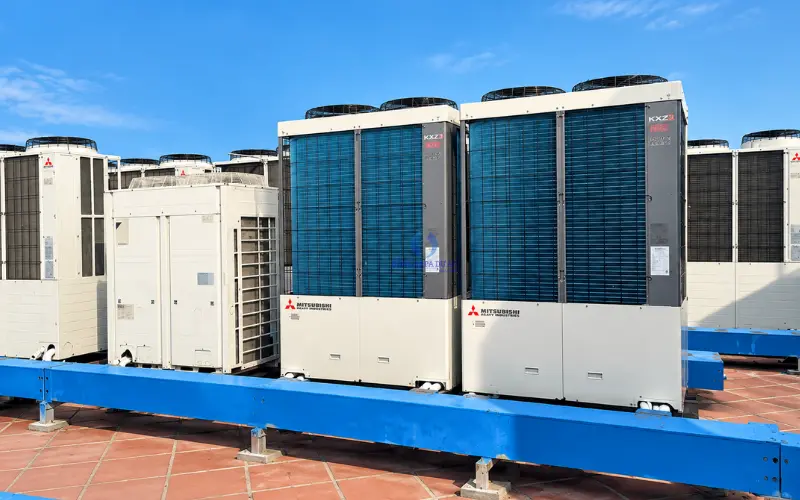

VRV vs. Multi Split: Which Air Conditioning System Is Better?
Both VRV and Multi Split air conditioning systems connect multiple indoor units to a single outdoor unit, yet they differ significantly in capacity, control capabilities, and application scope. For townhouses or multi-room apartments, a Multi Split system can be a practical solution for saving space and reducing initial investment costs. VRV systems, meanwhile, are often preferred for large villas, offices, and buildings that require independent control across multiple zones.
So, should you choose VRV or Multi Split air conditioning to meet your cooling requirements while optimizing long-term costs? This article compares VRV vs. Multi Split systems based on technical criteria and practical building applications.
1. What Are VRV and Multi Split Air Conditioning Systems?
Before determining which system is more suitable, it is important to understand the operating principles and key characteristics of both VRV and Multi Split air conditioning.
1.1. VRV/VRF Air Conditioning Systems
VRV (Variable Refrigerant Volume) là tên thương mại của công nghệ điều hòa môi chất lạnh biến thiên do Daikin phát triển. Trong khi đó, VRF (Variable Refrigerant Flow) là thuật ngữ chung được sử dụng cho các hệ thống có nguyên lý tương tự.
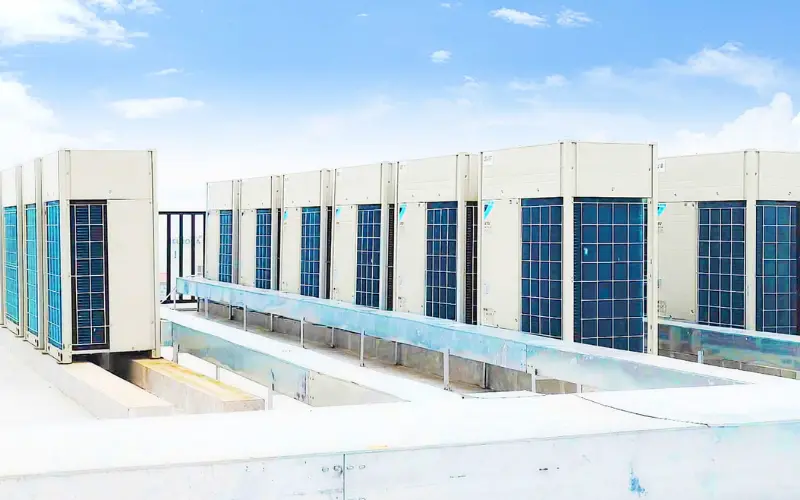
A VRV system allows a single outdoor unit or a combination of outdoor modules to serve multiple indoor units, adjusting refrigerant flow according to the cooling requirements of individual zones.
With zoning capabilities and support for centralized control, VRV/VRF systems are commonly used in luxury villas, offices, hotels, and buildings with multiple independently operated spaces.
1.2. Multi Split Air Conditioning Systems
A Multi Split air conditioning system also connects multiple indoor units to a single outdoor unit, typically accommodating two to five indoor units depending on the model, although some product ranges support more.
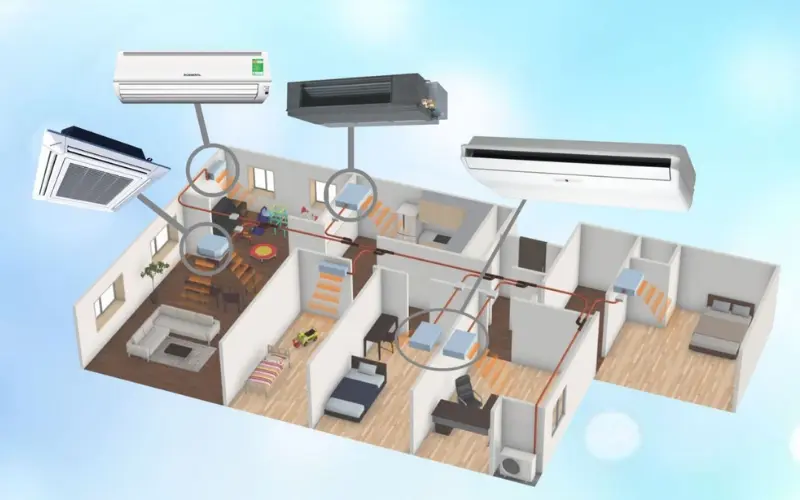
Depending on the equipment configuration, indoor units may be wall-mounted, ceiling cassette, or ducted types. Individual room control is available according to the system’s capabilities..
A key advantage of Multi Split systems is the reduced number of outdoor units required, making them particularly useful for apartments and townhouses with limited balcony space.
2. VRV vs. Multi Split: Detailed Technical Comparison
The main differences between VRV and Multi Split systems lie not in their shared configuration of one outdoor unit serving multiple indoor units, but in their application scale, capacity range, piping limitations, and operational management capabilities.
The main differences between VRV and Multi Split systems lie not in their shared configuration of one outdoor unit serving multiple indoor units, but in their application scale, capacity range, piping limitations, and operational management capabilities.
|
Criteria |
VRV/VRF Systems |
Multi Split Systems |
|
Application Scale |
Medium to large |
Small to medium |
|
Number of Indoor Units |
Wide range, with modular combinations available |
Typically 2–5, depending on the model |
|
Capacity Range |
Zone-based control with centralized management support |
Generally smaller |
|
Control Capabilities |
Generally supports longer piping runs and greater elevation differences |
Individual room control, depending on configuration |
|
Refrigerant Piping |
Generally higher |
Subject to individual room connections and system configuration |
|
Initial Investment Cost |
Generally higher |
Generally lower |
|
Energy Efficiency |
Good when properly designed and operated |
Good when correctly sized for the cooling load |
|
Maintenance |
Requires more specialized technical expertise |
Generally simpler |
|
Suitable Buildings |
Large villas, offices, hotels |
Apartments, townhouses, medium-sized villas |
The comparison shows that VRV systems offer advantages in organizing and managing air conditioning across multiple building zones, while Multi Split systems are better suited to multi-room cooling requirements on a more moderate scale.
However, floor area and room count alone should not determine system selection. Two buildings with the same floor area may require different solutions due to variations in architectural design and operating schedules.
3. VRV vs. Multi Split: Costs and Operating Efficiency
3.1. nitial Investment: Is Multi Split Really More Affordable?
For apartments or townhouses with relatively few rooms, Multi Split systems generally offer an initial cost advantage over comparable VRV configurations.
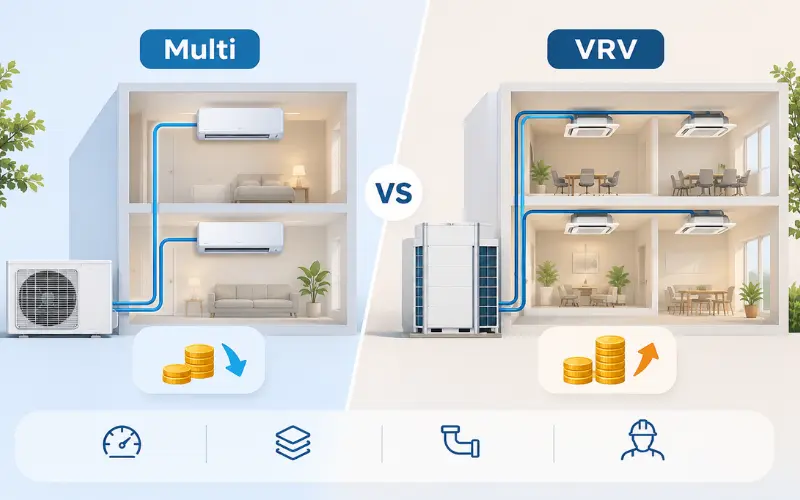
VRV systems, on the other hand, may involve higher costs due to equipment requirements, refrigerant piping networks, refrigerant branch joints, control systems, installation, and commissioning.
However, the installation costs of VRV and Multi Split systems also depend on:
- Total cooling capacity and the number of indoor units.
- Equipment types, brands, and control features.
- Refrigerant copper piping lengths and condensate drainage requirements.
- Installation conditions, ceiling space, and outdoor unit locations.
Therefore, cost estimates should be compared between solutions that meet equivalent operating requirements, rather than simply comparing equipment prices.
3.2. Which System Is More Energy Efficient?
Many assume that VRV systems are inherently more energy efficient than Multi Split systems because of their advanced technology. However, this assumption is not entirely accurate.
Both VRV and Multi Split air conditioning systems can incorporate inverter technology to adjust cooling capacity according to the cooling load.
Energy efficiency depends on factors such as simultaneous room usage, equipment efficiency under part-load conditions, the indoor-to-outdoor capacity connection ratio, and installation quality.
For example, a townhouse where only two bedrooms require cooling at night may operate efficiently with a properly sized Multi Split system. Conversely, an office with multiple zones operating on different schedules may benefit from the zoning capabilities of a VRV system.
Neither system is inherently more energy efficient in every application. Performance should be evaluated based on specific equipment models and actual operating conditions.
3.3. Maintenance Costs and Equipment Lifespan
Smaller Multi Split systems are generally easier to maintain and service.
VRV systems feature more complex control architectures and refrigerant piping networks, requiring specialized technicians and appropriate diagnostic equipment.
Regardless of the system selected, regular cleaning, refrigerant system inspections, condensate drainage checks, and operating condition assessments remain essential for maintaining performance and minimizing breakdowns.
>>> READ MORE: VRV vs. VRF: What’s the Difference? A Technical Comparison
4. VRV vs. Multi Split: Which System Is Right for Your Building?
A larger building does not necessarily require a VRV system. The appropriate solution should be selected based on cooling loads, the number of occupied zones, and architectural requirements.
4.1. Apartments or Townhouses with 3–5 Rooms
For a three-story townhouse with four bedrooms and several shared living areas, a Multi Split system is worth considering.
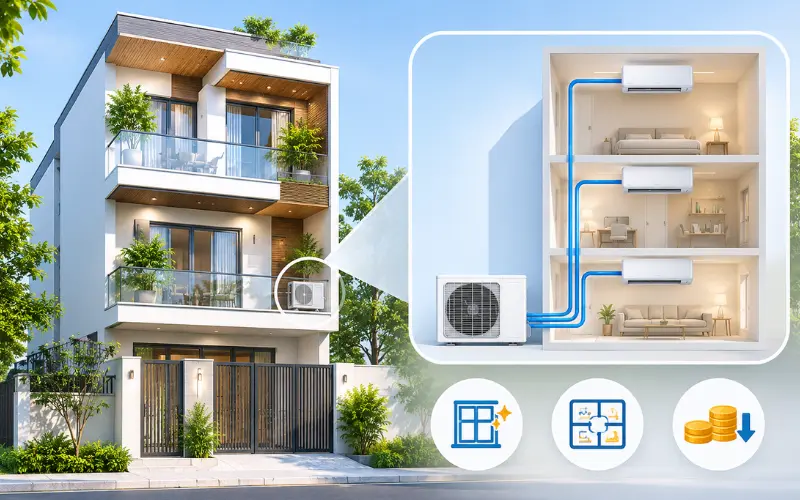
Using fewer outdoor units helps keep balconies uncluttered and minimizes the visual impact on the building’s façade..
However, it is important to verify the permitted number of connected indoor units, available capacity during simultaneous operation, and refrigerant piping length limitations.
If the budget is limited or the rooms are widely separated, homeowners should also consider comparing individual split air conditioning systems.
4.2. Luxury Villas with Multiple Rooms and Floors
For a four-story villa with multiple functional spaces and a preference for concealed indoor units to preserve interior aesthetics, VRV/VRF systems often offer greater advantages.

These systems support multiple indoor units, independent zoning, and flexible equipment selection to accommodate interior design requirements.
In particular, ducted indoor units can be integrated with discreet air diffusers and grilles to create an elegant interior while minimizing visible wall-mounted equipment.
Nevertheless, engineers must carefully evaluate refrigerant piping lengths, elevation differences, outdoor unit locations, and maintenance accessibility.
For buildings with a large number of rooms, VRV is often a solution worth prioritizing for technical evaluation.
4.3. Offices, Showrooms, and Hotels
Commercial buildings often experience varying cooling demands depending on occupancy levels and operating schedules.
VRV systems offer advantages when independent zone control or centralized management is required. Meanwhile, smaller offices with a limited number of rooms may still use Multi Split systems, provided the technical requirements are met.
An important consideration is that neither VRV nor Multi Split air conditioning systems inherently replace a dedicated fresh air ventilation system. Buildings with high occupancy levels still require appropriately designed ventilation to maintain indoor air quality.
Every building has unique operating requirements. Conducting site surveys and engineering calculations before selecting equipment helps avoid unnecessary oversizing and additional modification costs after installation.
5. Four Key Factors to Evaluate Before Installation
To make an informed choice between the two systems, project owners should evaluate the following four factors:

- Actual Cooling Load: Cooling capacity should not be calculated based solely on floor area. Solar exposure, glazing area, occupancy, and heat-generating equipment all influence cooling demand.
- Outdoor Unit Location: The installation must provide adequate heat rejection, noise control, appropriate piping distances, and sufficient maintenance access.
- Future Expansion: If renovations or additional rooms are planned, future cooling requirements should be considered during the design stage. Actual expansion capabilities remain subject to system configuration and manufacturer limitations.
- Total Cost of Ownership: Beyond equipment purchase costs, the assessment should include electricity consumption, maintenance, repairs, and other potential operating expenses.
hese considerations help prevent system selection based solely on initial price or prevailing market trends.
6. Frequently Asked Questions About VRV and Multi Split Air Conditioning
6.1. Is Multi Split More Energy Efficient Than VRV?
Neither Multi Split nor VRV can be considered universally more energy efficient. Electricity consumption depends on the efficiency of individual models, selected system capacity, the number of rooms operating simultaneously, and operating modes. A meaningful comparison requires evaluating both systems under equivalent operating conditions.
6.2. Should a Four-Story House Use VRV or Multi Split?
A four-story house with relatively few rooms and moderate cooling loads may still use a Multi Split system if its piping limitations can be satisfied. For villas with numerous functional spaces, higher cooling demands, or centralized control requirements, VRV is often a more suitable option to consider.
6.3. Does a VRV System Require Ductwork?
No. VRV systems can connect to various indoor unit types, including ceiling cassette, wall-mounted, and ducted units. Air distribution ductwork is required when ducted indoor units are used or when specified as part of a separate ventilation solution.
7. Conclusion: Choosing the Right Air Conditioning Solution with Dong SaPa
The comparison of VRV vs. Multi Split air conditioning systems demonstrates that each solution offers distinct advantages.
Multi Split systems are generally suitable for apartments, townhouses, and moderately sized buildings. VRV/VRF systems, meanwhile, offer advantages for large villas, offices, and buildings requiring independent control across multiple zones.
The key is not to choose the more expensive system, but to select a solution with the right capacity, appropriate functionality, and a cost that aligns with the project’s investment budget.
If you are considering VRV or Multi Split air conditioning, Dong SaPa can assist with site surveys, design consultation, equipment selection, and cost estimates tailored to your project’s specific requirements. Contact Dong SaPa at 0988 200 200 for professional advice on selecting the right air conditioning solution.
SAPA ENGINEERING CORPORATION
- Showroom: 456/72 Cao Thang (Extended), Hoa Hung Ward, Ho Chi Minh City.
- 24/7 Project Hotline: 0988 200 200 (Mr. Vinh)
- Email: quangvinh@dongsapa.com.vn
- Website: dongsapa.com.vn
Other news