
VRV vs. VRF: What’s the Difference? A Technical Comparison
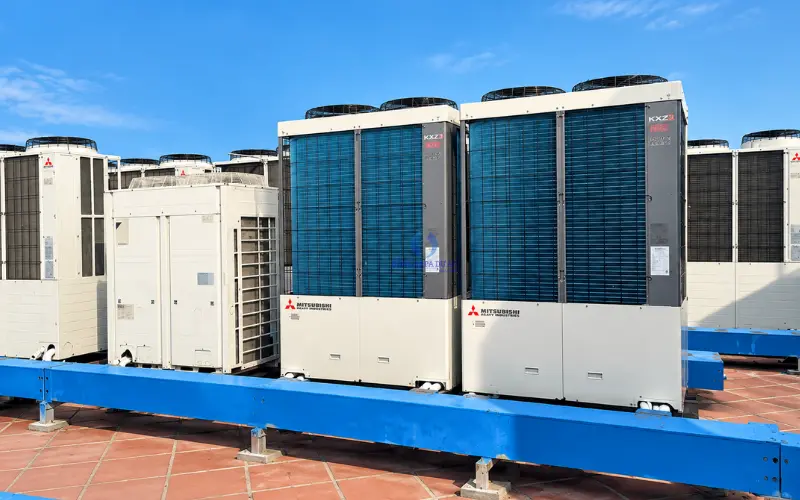
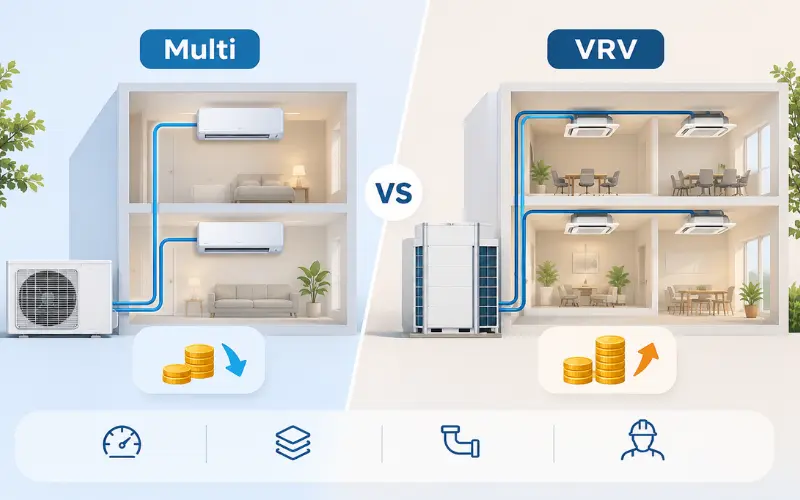
What is the difference between VRV and VRF? From a technical standpoint, both systems operate on essentially the same principle: adjusting refrigerant flow to match the cooling demand of individual zones. VRV is a proprietary name associated with Daikin, while VRF is the widely used industry term for air conditioning systems that regulate refrigerant flow according to demand.
Both VRV and VRF systems can connect a single outdoor unit or outdoor unit combination to multiple indoor units, provide independent temperature control across different zones, and use inverter technology. These similarities often leave building owners wondering why one project specifies VRV air conditioning while another uses a VRF system. Some even assume that VRV is a more advanced version of VRF. But is that assumption technically accurate?
So, when comparing VRV vs. VRF, is the difference primarily technological, or is it largely a matter of terminology? More importantly, what criteria should guide the selection of an HVAC system for a villa, hotel, office, or commercial building?
1. What Are VRV and VRF Air Conditioning Systems?
Before comparing VRV and VRF, it is important to understand what each term actually means.
1.1. What Is VRV?
VRV stands for Variable Refrigerant Volume. It refers to an air conditioning system that adjusts the amount of circulating refrigerant to match actual cooling demand.
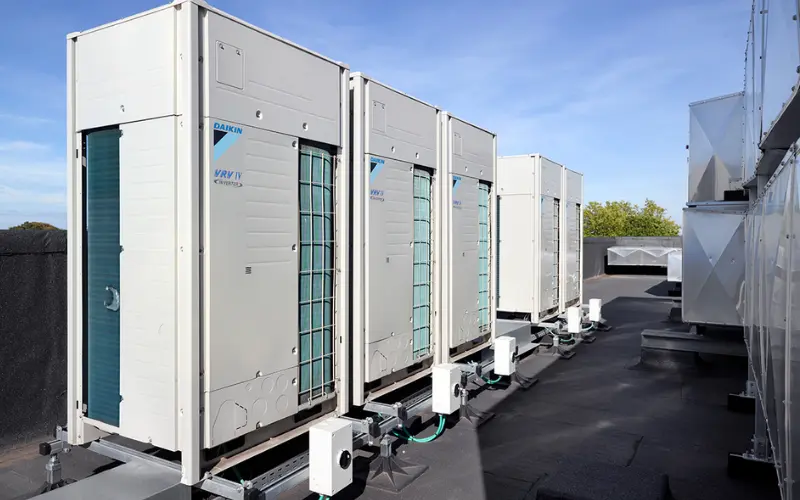
Rather than relying solely on simple on/off compressor operation, the system uses inverter technology to modulate compressor capacity according to cooling demand. A single system can serve multiple indoor units while allowing temperature control for individual rooms or zones.
An important distinction is that VRV is Daikin’s proprietary trademark. According to Daikin, the company introduced its VRV system in 1982, with the name derived from “Variable Refrigerant Volume.”.
1.2. What Is a VRF System?
VRF stands for Variable Refrigerant Flow, emphasizing the system’s ability to regulate refrigerant flow in response to changing cooling loads.
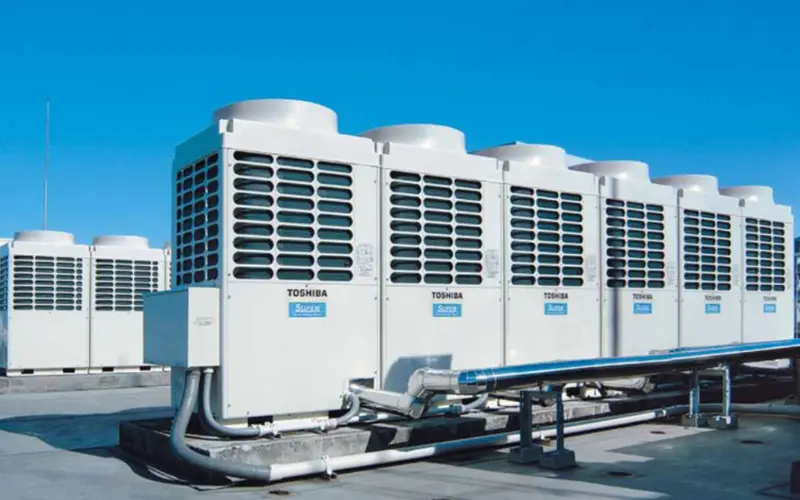
Today, VRF is widely used as a generic industry term for multi-zone air conditioning systems with variable refrigerant flow capabilities. Numerous HVAC manufacturers offer VRF systems, each with its own technologies, configurations, and control platforms.
*** Simply put, VRV and VRF are not two fundamentally different refrigeration technologies.
1.3. What Do VRV and VRF Have in Common?
At the system level, VRV and VRF air conditioning systems share several key characteristics::
- Adjust refrigerant flow to match actual cooling demand.
- Serve multiple rooms or zones within a single system.
- Allow independent temperature control for individual zones.
- Incorporate inverter technology.
- Support various indoor unit types, depending on the system.
- Support integration with centralized controls, Building Management Systems (BMS), or other management platforms, depending on the solution.
- Suit buildings with multiple zones operating on different schedules.
Therefore, understanding the differences between VRV and VRF starts with recognizing that they are not fundamentally opposing air conditioning technologies.
2. VRV vs. VRF: Detailed Comparison
A side-by-side comparison helps clarify the key differences between VRV and VRF systems.
|
Criteria |
VRV |
VRF |
|
Full name |
Variable Refrigerant Volume |
Variable Refrigerant Flow |
|
Operating principle |
Refrigerant modulation based on load demand |
Essentially the same operating principle |
|
Branding |
Daikin’s proprietary trademark |
Generic industry term used by multiple manufacturers |
|
Inverter technology |
Yes |
Yes |
|
Multi-zone temperature control |
Yes |
Yes |
|
BMS/IoT integration |
Depends on the product series and system configuration |
Depends on the manufacturer and product series |
|
Energy efficiency |
Depends on the model, configuration, and system design |
Depends on the model, configuration, and system design |
|
Cost |
Depends on project requirements and system configuration |
Depends on the manufacturer and system configuration |
|
Maintenance |
Based on system and manufacturer requirements |
Based on system and manufacturer requirements |
2.1. Differences in Terminology and Branding
The most obvious difference between VRV and VRF lies in their terminology and branding..
VRV is Daikin‘s proprietary trademark, while VRF has become the commonly accepted industry term for variable refrigerant flow technology. Therefore, the VRV or VRF designation alone does not indicate which system is more energy-efficient, technologically advanced, or better suited to a particular application.
2.2. The Real Differences Lie in Each Manufacturer’s Technology
The more meaningful differences emerge when comparing the technologies offered by individual manufacturers. This is where building owners and project developers should focus their attention.
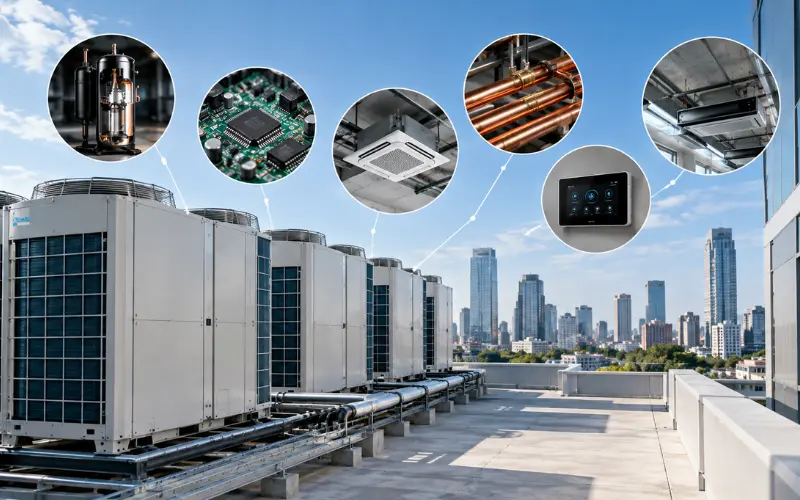
Specific systems may differ in compressor technology, inverter control algorithms, capacity ranges, refrigerant piping limitations, indoor-to-outdoor unit capacity ratios, operating temperature ranges, control functions, fault diagnostics, and energy management capabilities.
herefore, a more useful question is not “Is VRV better than VRF?” but rather:
“Which of these two specific HVAC systems is better suited to my project?”
2.3. Connectivity and Smart Control Capabilities
One notable advantage of both VRV and VRF systems is their ability to provide zone-based control and management.
Depending on the manufacturer and product series, these systems may support individual room controls, centralized control, BMS integration, operating status monitoring, energy management, fault alerts, and cloud-based connectivity.
These capabilities are particularly valuable for multi-story office buildings, hotels, showrooms, and other facilities that require centralized management of multiple zones.
2.4. Initial Investment and Maintenance Costs
It is inaccurate to assume that VRV systems are always more expensive than VRF systems, or vice versa.
The cost of a central air conditioning system depends on several factors, including total cooling load, equipment manufacturer and model, the number and types of indoor units, refrigerant piping lengths, control systems, fresh air ventilation requirements, installation conditions, and long-term maintenance and spare parts support.
To obtain a realistic cost estimate, the project must first undergo a site assessment, cooling load calculation, and system configuration review before a quotation can be prepared.
3. VRV/VRF Trends for Modern Buildings in 2026
The HVAC industry is moving beyond the question of whether an air conditioning system saves electricity. The broader concern is whether the system can operate efficiently under actual building load conditions.

3.1. Inverter Technology and Energy Optimization
Inverter technology allows compressors to modulate their capacity as cooling demand changes. This is a significant advantage because the cooling loads of offices, hotels, restaurants, and villas rarely remain at 100% throughout the day.
However, energy efficiency depends on more than inverter technology alone. Even a high-performance system may fail to achieve its expected efficiency if cooling loads are calculated incorrectly, equipment is improperly selected, refrigerant piping is poorly designed, or operating settings are not properly configured.
Emerging technologies are also advancing load-based control strategies. For example, Daikin has developed VRT Smart Control, which coordinates load data, compressor speed, and airflow control to optimize system operation according to actual demand.
3.2. Smart Controls, IoT, and Centralized Management
Another major trend is the increasing use of operational data in HVAC system management.
Rather than simply switching equipment on or off and adjusting temperature setpoints, modern systems can support a more comprehensive management process: Equipment → Controllers → Operational Data → Energy Management → System Optimization.
his approach is particularly valuable for office buildings, hotels, showroom chains, and facilities equipped with a Building Management System (BMS). In 2026, HVAC manufacturers continue to expand cloud connectivity, remote monitoring, and energy management solutions.
3.3. VRV/VRF Systems and the Green Building Trend
Energy efficiency, refrigerants with lower environmental impact, and zone-based load control are becoming increasingly important considerations in building design.
One example is the continued introduction of newer VRV systems using R-32 refrigerant in 2026. Daikin’s official BIM library has been updated with additional models from its latest VRV generation, including VRV 7 systems that use R-32 refrigerant.
DHowever, installing a VRV or VRF air conditioning system does not automatically qualify a building as a green building. HVAC is only one component of a broader approach that includes architectural design, the building envelope, lighting, fresh air ventilation, control strategies, and overall energy management.
4. Should You Choose VRV or VRF for Your Building?
After understanding the differences between VRV and VRF, the next question is: Which system should you choose?
From an engineering perspective, rather than asking whether VRV or VRF is better, building owners should determine which specific system best meets their project’s cooling load, architectural requirements, operational needs, and budget.
4.1. Villas and Penthouses
For luxury villas, key priorities often include aesthetics, low noise levels, individual room temperature control, and minimizing the visibility of HVAC equipment within interior spaces.
VRV/VRF configurations incorporating concealed ducted indoor units, ceiling cassette units, or other indoor unit types that complement the architectural design may be suitable options.
>>> READ MORE: Villa Air-Conditioning: Which System Is Best for Your Villa?
4.2. Offices and Commercial Buildings
For office buildings, zoning capabilities and centralized management are often higher priorities.
Different floors, meeting rooms, and workspaces may operate on different schedules. Therefore, an effective HVAC solution should provide independent zone control, optimize operation based on cooling demand, and support BMS integration when required by the project.
4.3. Hotels, Showrooms, and Restaurants
hese types of buildings often experience significant variations in cooling demand throughout the day.

Hotel rooms may be occupied or unoccupied, showrooms may experience peak visitor traffic at certain times, and restaurant cooling loads may fluctuate depending on occupancy, kitchen equipment, and service hours.
When properly designed, VRV and VRF systems can offer significant advantages through independent zone control, quiet operation, and operational flexibility.
4.4. Factories and Industrial Facilities
VRV/VRF systems should not automatically be considered the optimal solution for every industrial facility.
Engineers must evaluate floor area, ceiling height, heat generated by machinery, occupant density, temperature and humidity requirements, ventilation, fresh air supply, and the specific demands of the manufacturing process.
For certain large-scale facilities or applications with specialized cooling loads, chiller systems, rooftop or packaged air conditioning units, or hybrid HVAC solutions may be more appropriate.
5. Five Key Factors to Consider Before Choosing VRV or VRF
Rather than focusing solely on the manufacturer or initial equipment price, building owners should evaluate five key factors before selecting a VRV or VRF system:

- Actual Cooling Load: Cooling capacity must be calculated based on the building’s intended use, architectural characteristics, and internal and external heat gains.
- Number of Zones Requiring Independent Control: e more rooms or spaces that operate independently, the more important effective zoning becomes.
- Equipment Installation Requirements: The design must account for outdoor and indoor unit locations, refrigerant piping routes, condensate drainage, and adequate maintenance access.
- Life-Cycle Cost: Beyond initial investment costs, building owners should consider energy consumption, maintenance expenses, spare parts availability, and long-term operational performance.
- HVAC Contractor Expertise: Even high-quality equipment may underperform if cooling loads are incorrectly calculated, refrigerant piping is improperly installed, or system commissioning is not carried out correctly.
For this reason, when evaluating the advantages and limitations of VRV and VRF systems, Đông SaPa does not recommend making decisions based solely on equipment catalogs. A thorough site assessment and engineering design should be completed before finalizing the system configuration.
6. Conclusion: What Is the Main Difference Between VRV and VRF?
So, what is the main difference between VRV and VRF? In short, they are not fundamentally different air conditioning technologies. VRV is Daikin’s proprietary trademark, while VRF is the widely used industry term for variable refrigerant flow technology.
When investing in an HVAC system, the more important considerations are equipment models, energy efficiency, control technologies, connectivity, system design, and total life-cycle cost.
If you are unsure whether VRV, VRF, or another central air conditioning solution is best suited to your project, contact Dong SaPa, an experienced HVAC contractor. We provide site assessments, technical consultation, system design, and VRV/VRF installation services tailored to actual cooling loads and operating conditions.
Contact our project hotline at 0988 200 200 (Mr Vinh) to discuss the most suitable HVAC solution for your building with the Dong SaPa engineering team.
EAST SAPA ENGINEERING CORPORATION
- Showroom: 456/72 Cao Thang Street (Extended), Hoa Hung Ward, Ho Chi Minh City, Vietnam.
- 24/7 Project Hotline: 0988 200 200 (Mr. Vinh)
- Email: quangvinh@dongsapa.com.vn
- Website: dongsapa.com.vn
Other news