
Concealed Ducted Air Conditioning: Is It Energy Efficient?
Concealed ducted air conditioning is becoming increasingly popular in villas, luxury apartments, and modern offices thanks to its discreet design and flexible air distribution. Beyond aesthetics, however, many customers still have an important question: Is concealed ducted air conditioning energy efficient? Does the additional ductwork lead to higher electricity bills?
In reality, electricity consumption depends not only on the type of air conditioning system but also on equipment technology, ductwork design, and operating habits. Before making an investment decision, let’s examine the factors that truly determine the energy efficiency of concealed ducted air conditioning.
1. How Does Concealed Ducted Air Conditioning Work?
1.1. System Configuration and Operating Principles
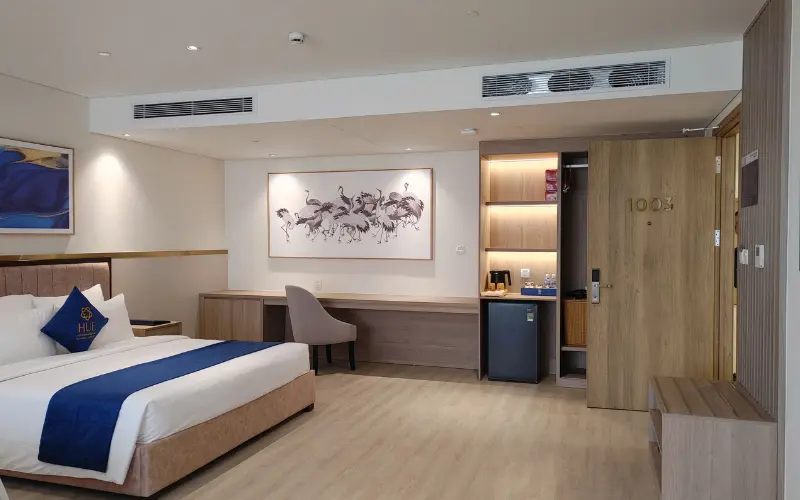
Unlike conventional wall-mounted air conditioners, concealed ducted air conditioning systems feature indoor units installed above a suspended ceiling. Once cooled, the air travels through a duct network and is distributed to different areas of the room through air outlets.
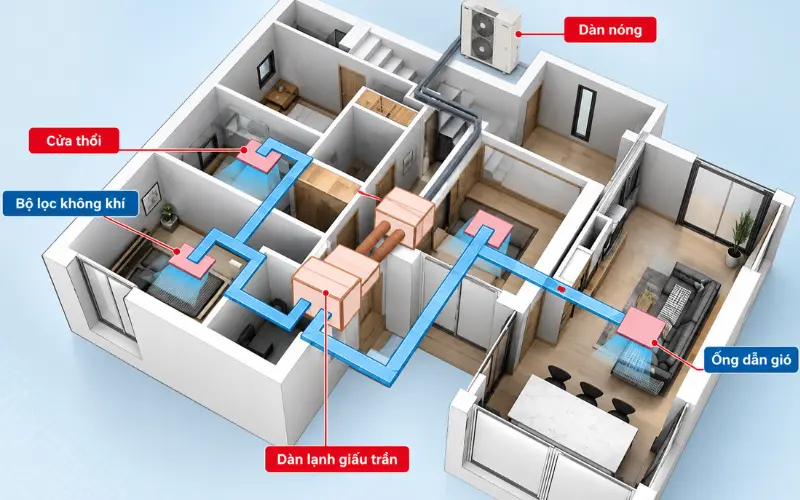
This configuration creates a clean, uncluttered interior, with only the air outlets visible and integrated into the architectural design.
However, the indoor unit fan must generate sufficient static pressure to move air through the ducts, elbows, and air outlets. This is an important consideration when evaluating system energy consumption.
It is important to distinguish concealed ducted systems from ceiling cassette air conditioners. Although both are installed within the ceiling space, cassette units typically discharge air directly through their decorative panels, while ducted systems distribute conditioned air through a network of ducts.
1.2. Does Inverter Technology Improve Energy Efficiency?
One important factor to consider when selecting air conditioning equipment is Inverter technology.
In concealed ducted air conditioning systems equipped with Inverter technology, the compressor can adjust its speed according to actual cooling demand rather than operating at a fixed capacity.
As the room temperature approaches the setpoint, the system can reduce its cooling output while maintaining stable indoor conditions, helping minimize unnecessary electricity consumption.
However, not all ducted air conditioners are equipped with Inverter technology. Actual energy savings also depend on the specific model, its capacity modulation range, and operating conditions.
2. Is Concealed Ducted Air Conditioning Energy Efficient?
Concealed ducted air conditioning can be energy efficient when the equipment is properly selected and the system is correctly designed. However, it does not automatically consume less electricity than wall-mounted air conditioners or other system types.
The key difference lies in how the system is designed and operated.
2.1. When Can Concealed Ducted Air Conditioning Operate Efficiently?
A ducted air conditioning system can achieve good energy performance when the following conditions are met:
- Proper system sizing: Equipment is selected based on actual cooling loads, avoiding both oversizing and undersizing.
- High-efficiency equipment: Priority is given to models with capacity modulation technology and appropriate energy efficiency ratings.
- Optimized ductwork: Duct layouts are designed to minimize unnecessary bends and control pressure losses.
- Effective insulation: Ductwork is properly insulated and sealed to minimize thermal losses and air leakage.
- Flexible controls: Operating schedules are adjusted to match the needs of different areas.
When these factors are properly coordinated, the system can maintain comfortable indoor temperatures while minimizing energy waste.
2.2. When Can Ducted Air Conditioning Consume Excessive Electricity?
Many people question whether ducted air conditioning consumes more electricity because it relies on fans and an additional duct network to distribute conditioned air.
In practice, electricity consumption may increase when duct runs are excessively long, contain too many bends, experience air leakage, or have inadequate insulation.
Dirty air filters, poorly insulated rooms, and continuous operation under high cooling loads can also reduce overall energy efficiency.
Therefore, rather than focusing solely on equipment brands or rated capacity, building owners should evaluate the quality of the entire system’s design and installation.
3. Key Factors Affecting Concealed Ducted Air Conditioning Energy Consumption
3.1. Equipment Capacity and Space Characteristics
A common mistake when selecting air conditioning equipment is determining cooling capacity based solely on room floor area
In reality, two rooms with similar floor areas may require different cooling capacities due to variations in ceiling height, solar exposure, glazing area, occupancy, and heat-generating equipment.
It is also important to distinguish between:
- Cooling capacity (BTU/h or kW of cooling): Indicates the amount of cooling the equipment can deliver.
- Electrical power input (kW): Indicates the rate at which the equipment consumes electrical energy during operation.
A system with a higher cooling capacity does not necessarily consume proportionally more electricity under all operating conditions. Equipment efficiency and actual operating load must also be considered.
3.2. Ductwork Design and Thermal Insulation
This is a particularly important factor that is often overlooked.
Duct systems with excessive bends, improperly sized cross-sections, or poorly planned layouts can increase airflow resistance, reduce airflow rates, and generate unwanted noise.
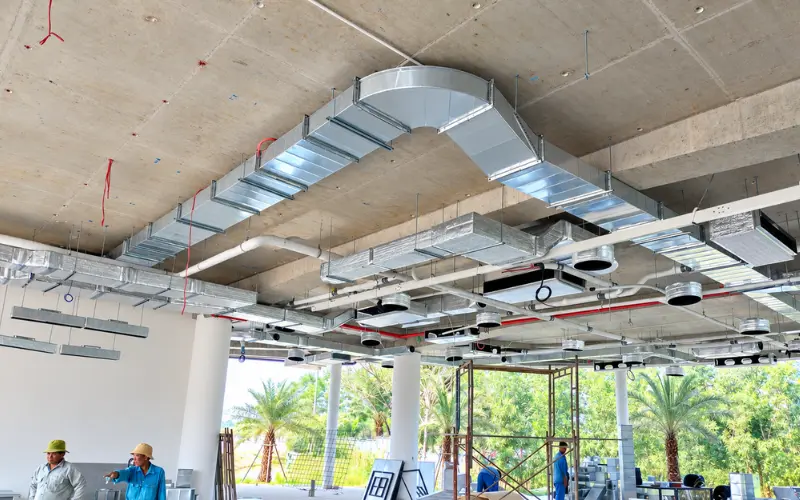
Depending on fan characteristics and control settings, pressure losses can also affect fan power consumption.
Inadequately insulated ductwork can also lead to unwanted heat gain, condensation, and reduced cooling efficiency.
For this reason, air conditioning system design and installation require a coordinated approach that considers equipment selection, available static pressure, duct routing, and air outlet placement.
3.3. Temperature Settings and Operating Hours
Even with the same system, different operating practices can result in significant variations in electricity consumption.
Setting the indoor temperature excessively low relative to outdoor conditions generally increases the cooling demand placed on the system.
Frequently opening doors, allowing direct sunlight into the space, or cooling unoccupied areas can also lead to unnecessary energy consumption.
Maintaining reasonable temperature settings, minimizing unwanted heat gain, and using appropriate operating schedules are simple ways to control energy costs.
>>> READ MORE: VRV vs. VRF: What’s the Difference? A Technical Comparison
4. Energy Consumption Comparison: Concealed Ducted, Wall-Mounted, and Floor-Standing Air Conditioners
When different air conditioning systems meet the same cooling requirements, which type offers better energy efficiency?
An objective comparison should consider air distribution, equipment efficiency, and the characteristics of the conditioned space.
|
Criteria |
Concealed Ducted |
Wall-Mounted |
Floor-Standing |
|
Air Distribution |
Through a duct network |
Directly from the indoor unit |
Directly from the indoor unit |
|
Fan Power Consumption |
Affected by ductwork resistance |
No external duct network |
No external duct network |
|
Inverter Technology |
Depends on the model |
Depends on the model |
Depends on the model |
|
Energy-Saving Potential |
Depends on equipment efficiency and system design |
Depends on equipment efficiency and operation |
Depends on equipment efficiency and operation |
|
Aesthetics |
Indoor unit concealed above the ceiling |
Indoor unit visible on the wall |
Occupies floor space |
|
Suitable Applications |
Villas, offices, and premium interiors |
Bedrooms and apartments |
Lobbies, halls, and large spaces |
Which Air Conditioning System Is More Energy Efficient?
There is no single answer that applies to every building.
For a small bedroom requiring independent temperature control, a high-efficiency Inverter wall-mounted air conditioner may be a practical and economical choice.
Concealed ducted air conditioning, on the other hand, offers advantages in spaces that require air distribution to multiple locations while maintaining high aesthetic standards.
To accurately assess energy consumption, equipment should be compared under equivalent cooling load conditions, using efficiency metrics such as the Cooling Seasonal Performance Factor (CSPF) or other relevant indicators specified by applicable standards.
5. How to Calculate Monthly Electricity Costs for Concealed Ducted Air Conditioning
One of the simplest ways to assess ducted air conditioning energy consumption is to estimate its monthly electricity costs.
5.1. Electricity Consumption Formula
Energy consumption (kWh) = Average power input (kW) × Operating hours (giờ)
Electricity cost = Energy consumption (kWh) × Electricity rate (VND/kWh)
Note that the calculation must use average electrical power input, not cooling capacity expressed in BTU/h.
5.2. Example: Estimating Monthly Electricity Costs
Consider a concealed ducted air conditioning system with the following operating assumptions:
- Average electrical power input: 1,5 kW.
- Daily operating hours: 8 hours/day.
- Operating day: 30 days/month.
- Assumed electricity rate: VND 2,500/kWh.
Monthly electricity consumption::
1,5 × 8 × 30 = 360 kWh/month
Estimated monthly electricity cost:
360 × 2.500 = 900.000 VND/month
This example is for illustration purposes only. It excludes taxes and does not reflect actual electricity tariffs. Average power consumption may vary depending on weather conditions, cooling loads, and operating modes.
6. Six Practical Ways to Improve Concealed Ducted Air Conditioning Energy Efficiency
Achieving long-term energy savings requires more than selecting high-quality equipment. Users should also consider the following practices:
6.1. Set a Reasonable Indoor Temperature
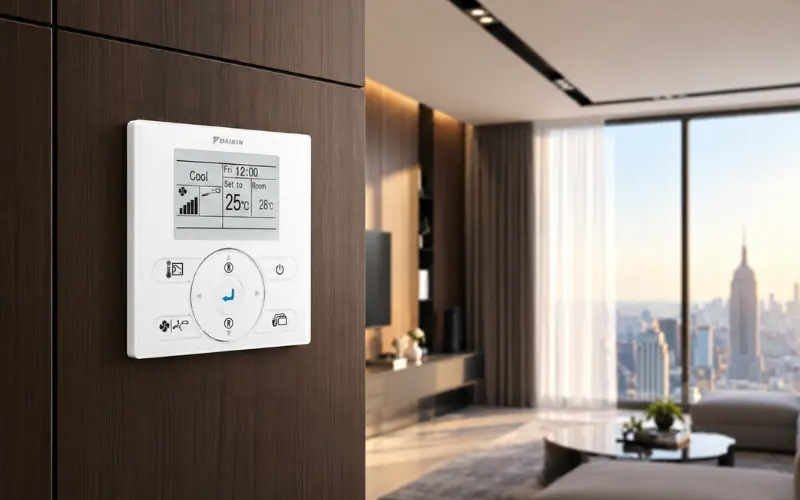
A temperature setting of 26–28°C may be considered where it meets indoor comfort requirements. Combining air circulation, humidity control, and measures to reduce heat gain can help maintain a comfortable indoor environment.
6.2. Choose High-Efficiency Inverter Equipment
Select equipment with suitable energy efficiency ratings, taking actual cooling loads and operating hours into account rather than focusing solely on rated capacity.
6.3. Minimize Unwanted Heat Transfer
Keep doors closed during operation, use window shading, and install appropriate insulation materials. In buildings with extensive glazing, effective solar heat gain control is particularly important.
6.4. Clean Air Filters and Perform Regular Maintenance
Dirty air filters increase airflow resistance, affecting airflow rates and heat transfer performance.
6.5. Optimize Operating Schedules
Use timers or control systems to prevent unnecessary operation outside required hours.
For buildings with multiple zones, independent zone control should be considered where the system configuration allows.
6.6. Work with a Qualified HVAC Design and Installation Contractor
An energy-efficient air conditioning system requires careful engineering from the design stage, including cooling load calculations, static pressure requirements, duct sizing, insulation, and airflow balancing.
Drawing on its HVAC expertise, Dong SaPa provides consulting, design, and installation solutions tailored to the specific requirements of each project, with a focus on reliable system performance and cost-effective operation.
7. Conclusion: Is Concealed Ducted Air Conditioning Worth Choosing for Energy Savings?
So, is concealed ducted air conditioning energy efficient? It can be, provided the equipment is properly selected, the ductwork is correctly designed, and the system is operated efficiently.
Although it is not inherently more energy efficient than wall-mounted air conditioning, it remains an attractive option for villas, offices, and buildings where aesthetics and indoor comfort are priorities.
Considering concealed ducted air conditioning for your project? Contact Dong SaPa at 0988 200 200 for professional advice on design and installation solutions tailored to your space, operational requirements, and energy budget.
With more than 23 years of experience, Dong SaPa is a professional HVAC contractor specializing in the design and installation of air conditioning and ventilation systems. Our solutions are developed to enhance cooling performance, improve energy efficiency in office environments, and support reliable, long-term system operation.
EAST SAPA ENGINEERING CORPORATION
- Showroom: 456/72 Cao Thang Street (Extended), Hoa Hung Ward, Ho Chi Minh City, Vietnam.
- 24/7 Project Hotline: 0988 200 200 (Mr. Vinh)
- Email: quangvinh@dongsapa.com.vn
- Website: dongsapa.com.vn
Other news