
VRV vs. Chiller: Choosing the Right HVAC System in 2026
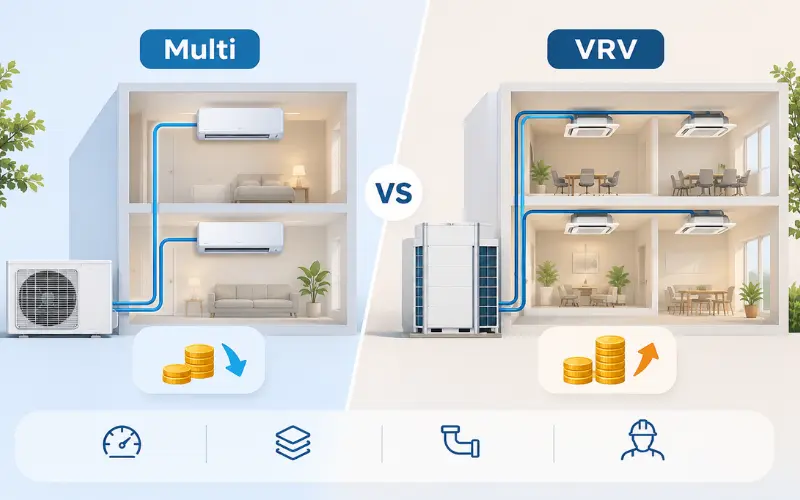
When investing in a central air-conditioning system, a VRV vs. Chiller comparison involves much more than equipment costs. The choice directly affects energy consumption, mechanical space requirements, operation, maintenance, and the total cost over the building’s lifecycle.
In 2026, as energy efficiency, smart controls, and emissions reduction become increasingly important, evaluating VRV and chiller systems requires looking beyond initial cost. The more important question is which solution best matches the project’s cooling load, operating schedule, zoning requirements, and actual MEP conditions.
1. Understanding VRV and Chiller Systems Before Comparing Them
1.1. How Do VRV/VRF Systems Work?
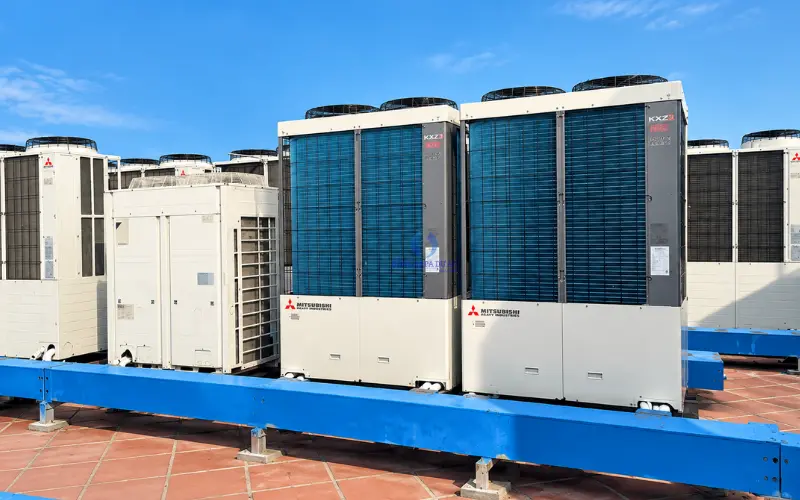
VRV/VRF systems use refrigerant to transfer heat between outdoor units and multiple indoor units. Inverter-driven compressors and electronic expansion valves regulate refrigerant flow and cooling capacity according to the actual demand of individual zones.
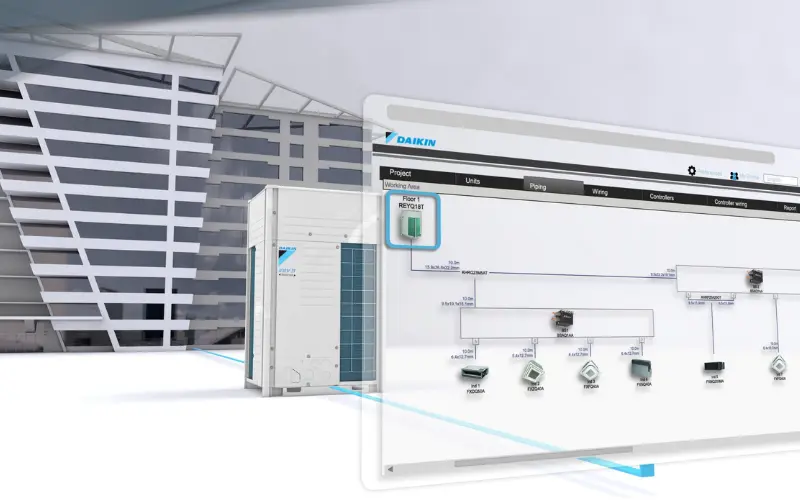
One of the key advantages of VRV systems is flexible zoning. Individual rooms or areas can be controlled relatively independently, making these systems well suited to offices, hotels, villas, and buildings where occupancy and operating schedules vary between zones.
1.2. How Do Chiller Systems Work?
Unlike VRV/VRF systems, chilled-water systems use chillers to produce chilled water, which is circulated to air handling units (AHUs) and fan coil units (FCUs) for space cooling.
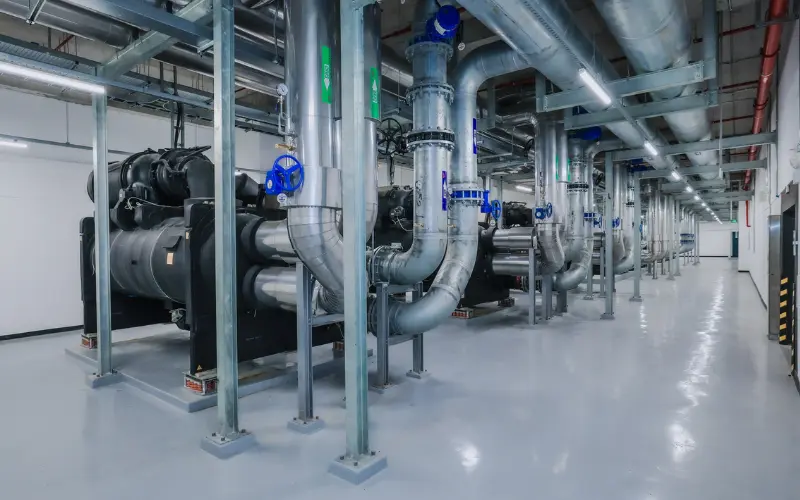
Water-cooled chiller systems may also include cooling towers, condenser water pumps, and associated piping networks. This system configuration is particularly suitable for buildings with high cooling loads, centralized operation, and large-scale plant management requirements.
2. VRV vs. Chiller: Seven Key Comparison Criteria
|
Criteria |
VRV/VRF |
Chiller |
|
Heat transfer medium |
Refrigerant |
Chilled water |
|
Capital cost |
Often favorable for medium-sized, multi-zone buildings |
More extensive auxiliary systems; cost depends on project scale |
|
Zone control |
Highly flexible |
Zoning through AHUs, FCUs, and control systems |
|
Mechanical space |
Generally less centralized plant space |
Requires chillers, pumps, and potentially cooling towers |
|
High cooling loads |
Modular configurations available |
Often advantageous for large-capacity applications |
|
Maintenance |
Multiple distributed components |
More centralized, with additional auxiliary systems |
|
Applications |
Offices, hotels, villas, multi-zone buildings |
Shopping centers, hospitals, factories, and large commercial buildings |
2.1. Initial Capital Expenditure (CAPEX)
When comparing VRV and chiller systems, the cost of the main equipment alone does not provide a complete picture.
For VRV systems, capital costs typically include outdoor and indoor units, copper refrigerant piping, insulation, refrigerant branch joints, control wiring, electrical systems, and installation.
Chiller systems may require chillers, AHUs or FCUs, chilled water pumps, piping, valves, electrical panels, and control systems. Water-cooled configurations also require cooling towers, condenser water pumps, and water treatment equipment.
Therefore, the cost per kilowatt from a small project should not be directly applied to a much larger development. As system capacity and project scale increase, the overall CAPEX structure can change significantly.
2.2. Operating and Maintenance Costs (OPEX)
VRV systems typically involve multiple indoor units and distributed outdoor equipment, requiring maintenance across numerous components. Refrigerant piping quality and leak prevention also play an important role in system reliability.
Chiller systems offer a more centralized plant configuration but involve additional components such as pumps, AHUs, FCUs, valves, and water piping. Water-cooled systems also require cooling tower maintenance and water treatment.
Investment decisions should therefore consider more than CAPEX alone. A life-cycle cost (LCC) assessment should account for initial investment, energy consumption, maintenance, repairs, and equipment replacement throughout the system’s service life.
2.3. Energy Efficiency and Operating Performance
Energy efficiency is one of the most frequently oversimplified factors when comparing VRV and chiller systems.

VRV/VRF systems can offer energy-efficiency advantages under variable-load conditions, particularly when different zones operate on different schedules. Inverter-driven compressors allow cooling capacity to adjust to changing demand.
However, modern chiller systems also incorporate variable-speed compressors, variable-speed pumping, and advanced control algorithms to optimize part-load performance. It is therefore inaccurate to assume that VRV systems are inherently more energy-efficient than chillers, or vice versa.
A proper efficiency assessment should consider COP, EER, IPLV/NPLV where applicable, part-load performance characteristics, and the energy consumed by pumps, fans, cooling towers, and control systems.
2.4. Installation Space and Architectural Integration
VRV systems do not require a large central chiller plant, but adequate space must still be allocated for outdoor units, refrigerant piping networks, service shafts, and ceiling installations.
Chiller systems require a central plant, pumping systems, water piping, AHUs or FCUs, and potentially cooling towers. Space planning must therefore consider mechanical rooms, rooftops, service shafts, and ceiling voids rather than focusing solely on the footprint of the main equipment.
2.5. Reliability, Maintenance, and System Expandability
VRV systems offer a relatively modular configuration, which can be advantageous for phased investments or the gradual expansion of individual building areas.
Chiller systems are well suited to centralized operation and may offer significant advantages in high-capacity applications. However, the reliability and actual performance of both technologies depend on system design, installation quality, commissioning, and ongoing maintenance.
2.6. Controls and Building Management System (BMS) Integration
VRV systems are particularly effective at zoning and individual room control. Newer generations increasingly support integration with building management systems (BMS) and remote. monitoring platforms.
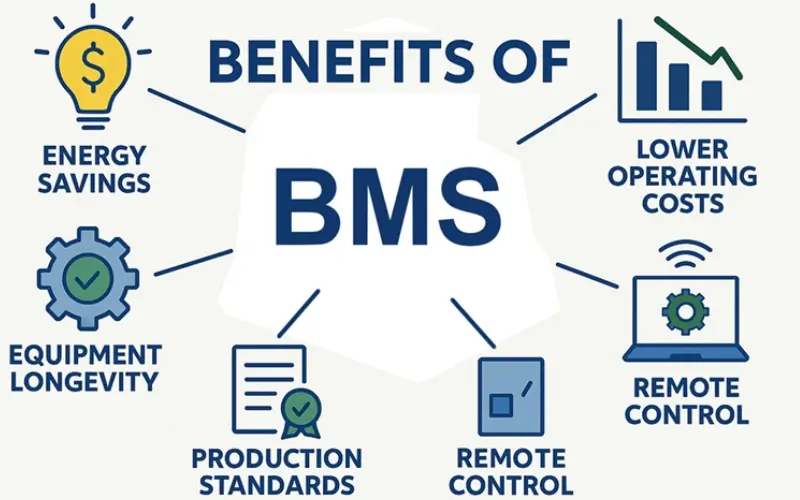
Chiller systems offer opportunities for central plant optimization, particularly in large commercial buildings, hospitals, shopping centers, and industrial facilities equipped with BMS infrastructure.
Current HVAC strategies increasingly combine BMS integration, cloud-based monitoring, and operational data analytics to identify abnormal conditions, track energy consumption, and optimize performance based on actual cooling demand.
2.7. Refrigerants and Environmental Considerations
Refrigerant selection is becoming an increasingly important consideration.
VRV systems circulate refrigerant to multiple areas within a building, making piping design, refrigerant charge management, and leak prevention particularly important.
Chiller systems distribute cooling through chilled water supplied to AHUs and FCUs, resulting in a different refrigerant distribution configuration. Equipment selection should also consider refrigerant type, Global Warming Potential (GWP), refrigerant recovery, and strategies for reducing emissions over the building’s lifecycle.
3. VRV vs. Chiller: Which System Is Right for Different Building Types?
3.1. Upscale Villas
VRV/VRF systems are worth considering for villas with multiple rooms, independent temperature-control requirements, and a strong emphasis on architectural aesthetics, particularly where space for a central plant is limited.
However, VRV should not be considered the default solution for every villa. System selection must still be based on cooling-load calculations and actual usage requirements.
3.2.Medium-Sized Offices and Multi-Zone Buildings
VRV systems are often a strong candidate when evaluating HVAC options for buildings with multiple zones, fluctuating cooling loads, different operating schedules, or phased construction requirements..
Independent zone control allows the system to respond more effectively to actual occupancy and operating conditions.
3.3. Hotels
Hotels illustrate why HVAC system selection should not be based on building type alone.
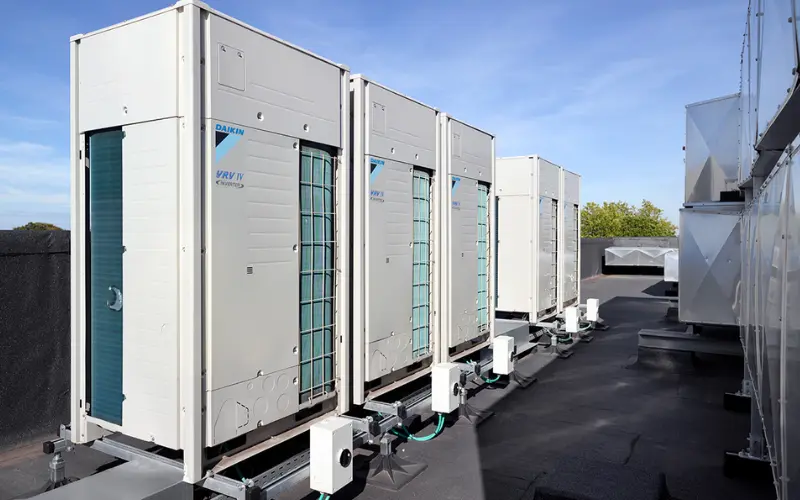
VRV systems can offer advantages when guestroom occupancy varies and individual room temperature control is required. For large hotels with substantial cooling loads, extensive public areas, and centralized facility management, chiller systems also warrant careful evaluation.
3.4. High-Rise Buildings, Shopping Centers, and Hospitals
Buildings with high cooling loads, extended operating hours, multiple AHUs, and centralized management requirements should carefully consider chiller-based solutions.
However, the final decision should be supported by cooling-load modeling and life-cycle cost analysis rather than the assumption that every large building necessarily requires a chiller system.
3.5. Factories and Industrial Facilities
For industrial facilities, it is essential to distinguish between comfort cooling and process cooling.
Where cooling is required for industrial processes, continuous operation, high redundancy, or large and relatively stable loads, chiller systems are often an important option. However, offices, support areas, and independently operated zones within the same facility may have different HVAC requirements.
4. Central Air-Conditioning System Trends in 2026
The current direction of the HVAC industry is not simply about VRV replacing chillers, or vice versa. The focus is shifting toward whole-system optimization based on actual operating loads.
Both technologies are advancing through inverter and variable-speed technologies, improved part-load efficiency, BMS integration, remote monitoring, and operational data analytics. At the same time, lower-GWP refrigerants, leak management, and lifecycle energy and carbon assessments are receiving increasing attention.
The more relevant question is therefore not which technology is more advanced, but which HVAC system configuration best matches the building’s operating profile.
5. Five Technical Considerations Before Choosing VRV or Chiller
5.1. Do Not Select a System Based on Floor Area Alone
Two buildings with the same floor area can have significantly different cooling loads due to solar exposure, glazing area, occupancy density, internal heat gains, outdoor air requirements, and building use.
5.2. Evaluate the Cooling-Load Profile, Not Just Peak Load
A building with a peak cooling load of 1,000 kW that operates at only 40–60% of that load for most of the time will have a different energy profile from a facility that continuously operates near peak capacity.
This is why part-load efficiency is a critical factor when comparing VRV and chiller systems.
5.3. Consider CAPEX, OPEX, and Life-Cycle Cost
A system with a lower initial investment does not necessarily deliver the lowest total cost over a 10–15-year period.

A simplified life-cycle cost framework can be expressed as:
Life-Cycle Cost = Initial Capital Cost + Energy Cost + Maintenance Cost + Repair and Replacement Costs
5.4. Review Architectural and MEP Constraints
Before finalizing the system selection, project teams should review mechanical room requirements, service shafts, ceiling voids, rooftop space, electrical supply, drainage, outdoor air provisions, noise constraints, and suitable locations for outdoor units or cooling towers.
5.5. Work with an HVAC Contractor Capable of Evaluating Both Options
An HVAC contractor or consultant should be capable of conducting site surveys, performing cooling-load calculations, analyzing load profiles, developing system designs, preparing CAPEX and OPEX estimates, comparing technical options, and coordinating equipment supply, installation, commissioning, and maintenance.
This approach enables project owners to make decisions based on technical data and long-term performance rather than initial equipment prices alone.
6. VRV vs. Chiller? Start with Your Building’s Requirements
As the above VRV vs. Chiller comparison demonstrates, neither VRV nor chiller technology is the best solution for every building. VRV/VRF systems are often worth considering when a project requires flexible zoning, variable cooling loads, independent area control, and reduced central plant space. Chiller systems, on the other hand, deserve careful evaluation for buildings with high cooling loads, extended operating hours, centralized management requirements, or relatively stable cooling demand.
Therefore, rather than focusing solely on which system is more cost-effective when comparing VRV and Chiller systems, project owners should evaluate cooling loads, operating load profiles, CAPEX, OPEX, life-cycle costs, and the project’s architectural and MEP constraints.
Selecting the right system during the design stage not only helps meet cooling requirements but can also reduce energy consumption, limit unexpected costs, and improve operating efficiency over the long term.
If you are considering a VRV vs. Chiller comparison for your project, contact Dong SaPa at 0988 200 200 for a site assessment, cooling-load calculations, and a technical evaluation of suitable HVAC solutions before making an investment decision.
EAST SAPA ENGINEERING CORPORATION
- Showroom: 456/72 Cao Thang (Extended), Hoa Hung Ward, Ho Chi Minh City
- 24/7 Project Hotline: 0988 200 200 (Mr. Vinh)
- Email: quangvinh@dongsapa.com.vn
- Website: dongsapa.com.vn
Other news