
What Is Elastocaloric Cooling? The Future of Refrigeration
For decades, most air-conditioning and refrigeration systems have relied on vapor-compression cycles, using refrigerants to absorb and reject heat. Although this technology is highly mature, the climate impact of certain high-global-warming-potential (GWP) refrigerants continues to drive the HVAC industry toward alternative cooling technologies.
One promising area of research is elastocaloric cooling, a technology that produces thermal effects through mechanically induced changes in solid materials. Rather than simply developing new refrigerants, researchers are exploring a more fundamental question: Could future cooling systems generate refrigeration through changes in the physical state of materials themselves?
This concept forms part of a broader field known as caloric cooling, which includes several solid-state cooling technologies that could help shape the next generation of HVAC systems.
1. What Is Elastocaloric Cooling?
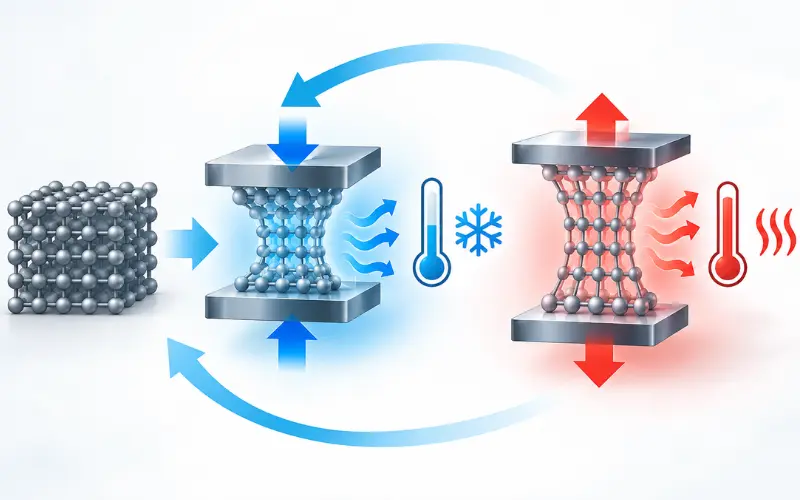
Elastocaloric cooling is a solid-state cooling approach that uses the thermal response of certain materials when mechanical stress is applied or released. As the material undergoes changes in its physical state or crystal structure, it can release or absorb heat. By incorporating these changes into a controlled thermodynamic cycle, researchers can produce a cooling effect.
1.1. From Thermomechanical Effects to Solid-State Cooling
The relationship between mechanical deformation and temperature is not a new discovery. Thermoelastic phenomena have been studied since the nineteenth century. However, advances in functional materials, particularly shape memory alloys (SMAs), have established elastocaloric cooling as an important area of solid-state refrigeration research.
Among these materials, nickel-titanium (NiTi) alloys have attracted considerable attention because they can undergo reversible, stress-induced phase transformations.
Research reviews describe elastocaloric cooling as a technology that harnesses the thermal effects associated with stress-induced phase transitions in shape memory alloys to perform refrigeration cycles.
1.2. How Does Elastocaloric Cooling Work?
The operating principle of elastocaloric cooling can be understood through a simplified cycle::
Apply mechanical stress → Material undergoes a phase change and releases heat → Reject heat to the surroundings → Release mechanical stress → Material returns toward its original state and absorbs heat → Produce a cooling effect.
In many shape memory alloys, the underlying mechanism involves a reversible, stress-induced martensitic phase transformation. In this sense, elastocaloric materials can be viewed as a form of solid-state refrigerant..
However, elastocaloric cooling does not eliminate the need for energy. Practical systems still require power to apply mechanical forces, transfer heat, operate controls, and drive auxiliary components.
2. Three Major Categories of Caloric Cooling Technologies
Elastocaloric cooling is not the only approach being investigated. It belongs to a broader family of technologies known as caloric cooling.
These technologies generally use external stimuli to change the thermodynamic state or entropy of specialized materials, enabling them to absorb and release heat. They are commonly classified according to the type of stimulus applied.
2.1. Mechanocaloric Cooling: Using Mechanical Forces
Mechanocaloric cooling includes two notable approaches: elastocaloric and barocaloric cooling.
Elastocaloric cooling primarily relies on tensile or compressive stress. Certain materials can undergo significant temperature changes through phase transformations or other thermomechanical responses.
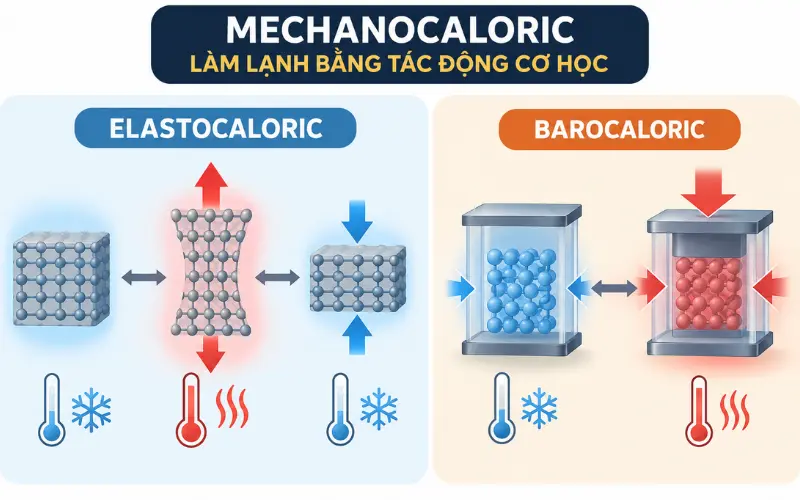
One of the main challenges facing elastocaloric cooling is the need for materials to withstand an extremely large number of loading cycles throughout a device’s operating life. Mechanical fatigue, cyclic degradation, and the relatively high actuation forces required by some materials remain important obstacles to widespread commercialization.
2.2. Magnetocaloric Cooling: Using Magnetic Fields
Magnetocaloric cooling uses changes in magnetic fields to alter the thermodynamic state of specialized materials.
When a magnetic field is applied or removed, the material’s entropy changes, producing heating or cooling effects. Magnetocaloric refrigeration is among the most extensively studied branches of caloric cooling.
A notable advantage is that it does not rely on conventional HFC refrigerants. However, challenges remain in magnetic materials, magnet assemblies, heat transfer, system size, cost, and capacity scaling.
2.3. Electrocaloric Cooling: Using Electric Fields
Electrocaloric cooling uses electric fields to induce thermal changes in dielectric or ferroelectric materials.
As an electric field is applied or removed, changes in material polarization and entropy cause heat to be released or absorbed.
Electrocaloric technology is particularly attractive for compact applications, including electronics cooling and thermal management. Nevertheless, translating promising material-level temperature changes into practical refrigeration capacity remains a significant engineering challenge.
Together, elastocaloric, magnetocaloric, electrocaloric, and barocaloric technologies represent different pathways toward solid-state cooling systems that could reduce reliance on conventional vapor-compression refrigeration.
3. Why Is Elastocaloric Cooling Considered Promising?
3.1. Potential to Reduce Dependence on High-GWP Refrigerants
Unlike conventional vapor-compression systems, elastocaloric cooling uses solid materials as the primary source of its thermal effect.
This creates opportunities for developing refrigerant-free cooling technologies that do not require the refrigerants commonly used in traditional vapor-compression cycles. Such systems could eliminate direct emissions associated with leakage of certain high-GWP refrigerants.
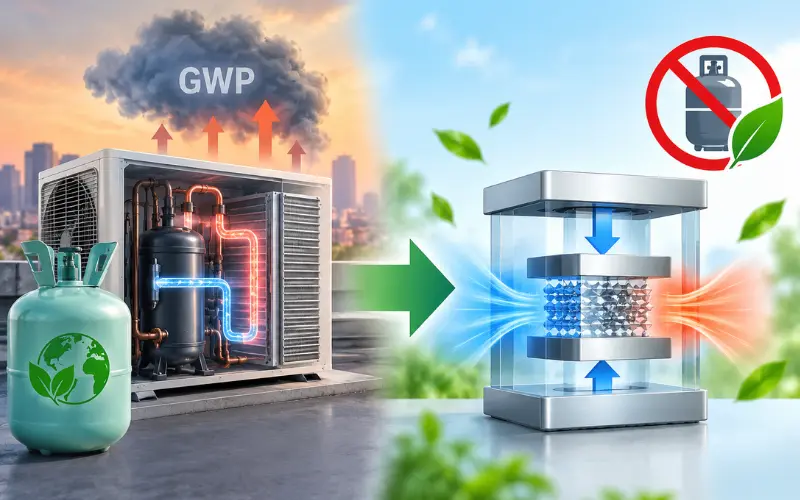
This potential makes elastocaloric cooling particularly relevant to efforts to reduce the climate impact of refrigeration and air-conditioning technologies.
>>> READ MORE: Is R-410A Being Phased Out? The Shift Toward R-32 and Next-Generation Refrigerants
3.2. Potential for High Energy Efficiency
Caloric cooling technologies have also attracted interest because of their potential for high thermodynamic efficiency. However, theoretical potential must be distinguished from the performance of a complete HVAC system.
At present, it would be premature to conclude that elastocaloric cooling is consistently more energy-efficient than VRV/VRF or chiller systems. Actual performance depends on actuators, heat exchangers, mechanical losses, control strategies, and other system components.
3.3. Progress from Laboratory Research to Kilowatt-Scale Cooling
A notable milestone emerged in 2025, when a study published in Nature demonstrated an elastocaloric cooling device based on compression-loaded NiTi tubes arranged in a multi-cell configuration.
During testing over 500,000 cycles, the system achieved a cooling capacity of 1,284 W on the heat-transfer-fluid side at zero temperature lift.
The researchers arranged the SMA elements in series while allowing the heat-transfer fluid to flow through parallel paths. This design enabled them to use more active material while limiting pressure losses in the fluid circuit.
The experimental device was also used to cool a 2.7 m³ demonstration enclosure, reducing its internal air temperature to approximately 21–22°C, while the surrounding temperature was approximately 30–31°C.
These results represent meaningful progress from small laboratory prototypes toward kilowatt-scale cooling. However, they do not establish that elastocaloric technology is ready to replace commercial air-conditioning systems.
4. Three Major Barriers to Commercializing Elastocaloric Cooling
4.1. Material Fatigue Life
A practical air-conditioning system may need to withstand an enormous number of operating cycles. When elastocaloric materials are repeatedly stretched or compressed, fatigue, microcracking, permanent deformation, or degradation of thermomechanical properties may occur.
Material fatigue life therefore remains one of the critical challenges that elastocaloric cooling must overcome before widespread commercial deployment.
4.2. Material and Manufacturing Costs
An effective elastocaloric material must offer more than a large temperature change. It must also demonstrate high durability, low hysteresis, stable performance over repeated cycles, and the potential for cost-effective mass production.
Consequently, materials engineering and manufacturing economics are closely linked in the commercialization of elastocaloric cooling.
4.3. Scaling Up from Materials to Complete HVAC Systems
A material capable of producing a large temperature change (ΔT) under laboratory conditions does not necessarily translate into an air-conditioning system with a high coefficient of performance (COP).
Developing a commercially viable HVAC system requires manufacturers to address multiple challenges simultaneously, including actuators, heat exchangers, mechanical losses, controls, equipment size, noise, reliability, maintenance, and life-cycle costs.
Bridging the gap between a promising physical phenomenon and a competitive HVAC product may be one of the most demanding stages of development.
5. The Future of HVAC: Can Elastocaloric Cooling Replace Conventional Refrigerants?
Recent advances suggest that elastocaloric cooling is a technology worth watching. Nevertheless, it would be inaccurate to describe it as an imminent replacement for vapor-compression air-conditioning.
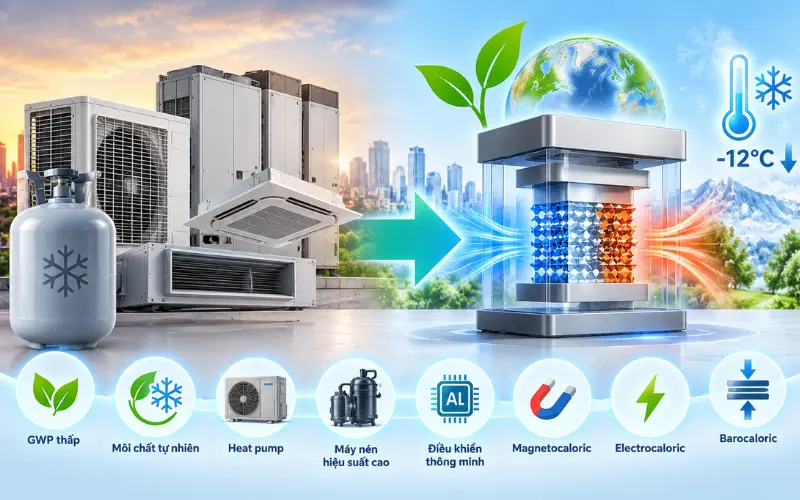
Today’s VRV/VRF, chiller, and other vapor-compression systems benefit from decades of development in supply chains, engineering standards, maintenance practices, and operational experience.
Meanwhile, the future of HVAC is not limited to elastocaloric technology. The industry is also advancing lower-GWP refrigerants, natural refrigerants, heat pumps, high-efficiency compressors, intelligent controls, and other Meanwhile, the future of HVAC is not limited to elastocaloric technology. The industry is also advancing lower-GWP refrigerants, natural refrigerants, heat pumps, high-efficiency compressors, intelligent controls, and other solid-state cooling approaches, including magnetocaloric, electrocaloric, and barocaloric technologies. approaches, including magnetocaloric, electrocaloric, and barocaloric technologies.
Elastocaloric research is also expanding into new operating conditions. A recent study published in Nature demonstrated a device using a low-transition-temperature NiTi alloy that achieved a cold-side temperature of −12°C, indicating potential for applications below freezing.
Dong SaPa’s Perspective: Monitoring Emerging Technologies While Prioritizing Practical Solutions
For engineers, contractors, and project owners, understanding elastocaloric cooling is about more than learning how an emerging technology works. It also raises a broader question about the future of refrigeration: Could the industry eventually move beyond simply searching for better refrigerants?
In the near term, real-world projects must continue to evaluate established HVAC solutions, including VRV/VRF, and chiller systems, based on cooling loads, energy performance, building functions, technical standards, operational requirements, and life-cycle costs.
Over the longer term, advances in caloric materials and solid-state cooling architectures may enable fundamentally different approaches to air conditioning.
6. Conclusion: Elastocaloric Cooling Opens a New Path for Refrigeration Technology
What is elastocaloric cooling? It is a solid-state cooling approach that uses the thermal response of materials to mechanical stress. The technology belongs to the broader caloric cooling family, alongside magnetocaloric, electrocaloric, and barocaloric systems.
Elastocaloric cooling offers the potential to reduce dependence on high-GWP refrigerants and support the development of new refrigerant-free cooling technologies. However, challenges involving material fatigue life, cost, heat transfer, system engineering, and commercialization still require further research and development.
CProgress toward kilowatt-scale cooling demonstrates that elastocaloric technology is moving beyond fundamental materials research toward increasingly practical prototypes. Rather than viewing elastocaloric cooling as a technology about to replace conventional air conditioners, it is more appropriate to regard it as one of the promising candidates for future generations of HVAC technology.
Follow dongsapa.com.vn for more insights into HVAC technologies, industry trends, and emerging approaches to air-conditioning system design, installation, and operation.
EAST SAPA ENGINEERING CORPORATION
- Showroom: 456/72 Cao Thang Street (Extended), Hoa Hung Ward, Ho Chi Minh City, Vietnam.
- 24/7 Project Hotline: 0988 200 200 (Mr. Vinh)
- Email: quangvinh@dongsapa.com.vn
- Website: dongsapa.com.vn
Other news